- 01Chase the niche no one else wants
- 02Turn your product into a free diagnostic
- 03Let the product write its own marketing
- 04Fund the ad that already works before you diversify
01 Snapshot
The one-glance read on who they are and how they grow. Each point is verifiable from the receipts above.
An autonomous AI agent that writes, optimizes, and re-writes SEO content to rank client sites on both Google and AI answer engines like ChatGPT, at ~$47,089 in publicly reported MRR across 166 subscriptions.
Paid-led, anchored by a Google ad campaign that has stayed active for over a year rather than a founder-audience or single viral-launch motion.
~48,482 monthly visits (+118.6% over the last 3 months), $47,089 MRR / 166 subscriptions / ~$284 blended ARPU, and 11 active Google ads plus 6 active Meta ads as of 2026-07-03.
As of 2026-07-03, a fresh Meta ad batch first shown between mid- and late-June 2026 is testing new fear- and audit-lead hooks around AI search invisibility.
Ads tout "100+ YC-backed companies" as customers, meaning RankAI's own Y Combinator batch network doubles as its earliest buyer base, while the actual growth engine underneath is a paid Google campaign and a content engine the product writes about itself, not a viral launch or founder following.
02 How it unfolded
The order the channels came online. Sequence is strategy: what they did first, and what they layered on once demand existed.
03 Traffic & channel mix
Estimated demand, the channel split behind it, and the keywords and referrers doing the work. Directional modeling, not audited analytics.
Traffic sources
Top search keywords
| Keyword | Volume | Weight | CPC |
|---|---|---|---|
| rankai | 2.6k | $4.99 | |
| rank ai | 1.9k | $1.38 | |
| google people first content update | 140 | - | |
| rankai free 10 articles | 120 | - | |
| rankai pricing | 90 | - |
Closest competitors by audience
RankAI pulls an estimated ~48,482 monthly visits, up 118.6% over the last 3 months. Direct traffic leads the mix at 44.8%, Social Organic follows at 25.5%, and Search Organic contributes 13.3%; Referrals add another 12.6%, while the rest, display ads, email, and Gen AI search, totals under 4% combined. That last sliver is worth pausing on: Gen AI referrals, the exact channel RankAI sells visibility into, account for just 0.3% of its own traffic, meaning the product isn't yet driving its own acquisition through the answer engines it optimizes clients for.
On keywords, demand is overwhelmingly branded: "rankai" (2,580 searches/mo) and "rank ai" (1,880 searches/mo) dwarf everything else, while a commercial-intent term like "rankai pricing" pulls only 90 searches/mo, meaning most search demand is people who already know the name rather than category shoppers comparing "AI SEO" tools. Among the competitor set, rankscale.ai sits closest in name and category (AI-search-rank tracking), while grazitti.com, an established full-service digital marketing agency, and pagetraffic.com, a traditional SEO services shop, show RankAI's traffic is being benchmarked against the legacy agencies it markets itself as replacing, not just AI-native rivals.
04 Organic content
The specific pages earning their organic search traffic, and the pattern behind why they rank. Adapt the format, not the topic.
The five pages earning RankAI's organic traffic split into two moves: three are agency-comparison roundups ("seo packages for small business," "top affordable seo services and agencies," "top on-page seo service providers"), and two target a specific underserved niche, adult-industry SEO, where the site ranks #2 for "adult search engine optimization." Roundup listicles are a low-cost, high-intent format that ranks well because they match exactly how buyers search when comparing vendors, and the adult-SEO guides likely rank easily because most mainstream SEO agencies avoid that vertical for brand-safety reasons, leaving the query space comparatively open. The strategic read: RankAI is using its own content-generation product to write the very comparison and niche-vertical pages that would otherwise take a content team months to produce, letting the output double as a live product demo.
Top pages by organic traffic
05 Channel map
Not traffic share. How much weight the growth system actually puts on each channel, with a one-line read on the role it plays.
What drove growth
06 The motions doing the work
For founder-led SaaS the breakdown shifts from ads to traction: where the first users came from, how the founder grows it in the open, and the compounding organic surface.
RankAI's public launch attempt barely registered, and the evidence shows the team shifted to paid search almost immediately afterward rather than relaunching until something stuck.
On 2024-11-13 the team posted "Show HN: Rankai, Automated SEO with AI," describing it as an AI agent that "pushes SEO blogs and code fixes automatically to your site," but the post closed at just 2 points and 0 comments.
Google Ads data shows their oldest active campaign began 2024-11-19, six days after the Show HN post, and it's still running as one of the proven-winner ads covered above, suggesting the team moved from a launch-moment bet to a paid-acquisition bet within days.
Dig deeper+2▾
There's no Product Hunt listing or founder Reddit launch post alongside the Show HN, so unlike companies that stack a Product Hunt, Show HN, and Reddit post on one day, RankAI's public launch ran on a single weak surface before paid took over.
With no founder-interview or viral-moment evidence available, the visible growth curve looks like a steadily funded paid-search bet rather than a single inflection event.
There is no visible founder-audience motion to report here: the homepage links to a company X and LinkedIn profile, but no follower count, post cadence, or interview material was captured for either co-founder.
Co-founders Dyllan Liu (CEO) and Hugo Zhan (CTO) have no audited social presence or founder-interview evidence in this pass, so build-in-public cannot be scored as a channel for RankAI.
Every Reddit mention is a third party naming RankAI inside "best AI SEO agency" comparison threads (scores of 28, 14, and 4 across b2bmarketing, digital_marketing, and AI_Application), not the founders posting progress or lessons themselves.
Dig deeper+1▾
Since RankAI's core offering is autonomous content generation, its own blog functions as a public demonstration of the tool working, arguably standing in for the founder-voice channel other companies build through personal posting.
Organic search is a minority channel at 13.3% of total visits, but it's a deliberate minority: the pages earning it are themselves a working demo of the AI that writes them, as covered above.
Against five organic pages pulling measurable traffic, 11 active Google ads (the oldest running over a year) show paid search is still the dominant, proven channel while the content engine looks earlier-stage.
The top Google creative reads "95% Cheaper Than Agencies - Google & ChatGPT Traffic," a bold cost-comparison hook, while the top Meta creative opens "IS CHATGPT RECOMMENDING YOUR COMPETITORS?," a problem-agitation hook that turns AI-search invisibility into a fear before pitching the product.
Dig deeper+1▾
Several of the highest-recurring ads push a free "AI Search Visibility Audit" rather than a direct sale, meaning the ad spend is buying a lead-capture form, not just impressions.
07 Paid ads
This founder-led SaaS also runs paid acquisition. Here are the live ads doing the work, each with the X-ray and a play you can adapt.
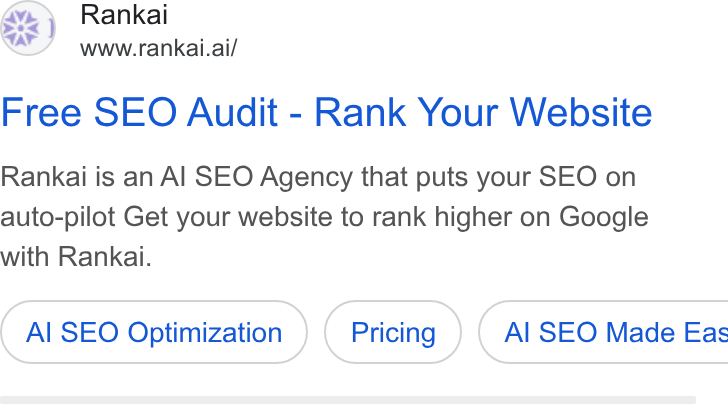
- Running
- 433 days (longevity = it's converting)
- Hook
- Rankai www.rankai.ai/ Free SEO Audit - Rank Your Website
- CTA / offer
- Free SEO Audit
- Audience
- Website owners or businesses looking to improve their search engine ranking, indicated by the phrases 'Rank Your Website' and 'puts your SEO on auto-pilot'.
Why it works. Uses a free audit as the low-friction entry point for site owners who want ranking help but aren't ready to buy yet.
Headline benefit statement: 'Free SEO Audit - Rank Your Website' Frame your free tool or audit as step one toward the outcome your buyer wants, not as an isolated giveaway.
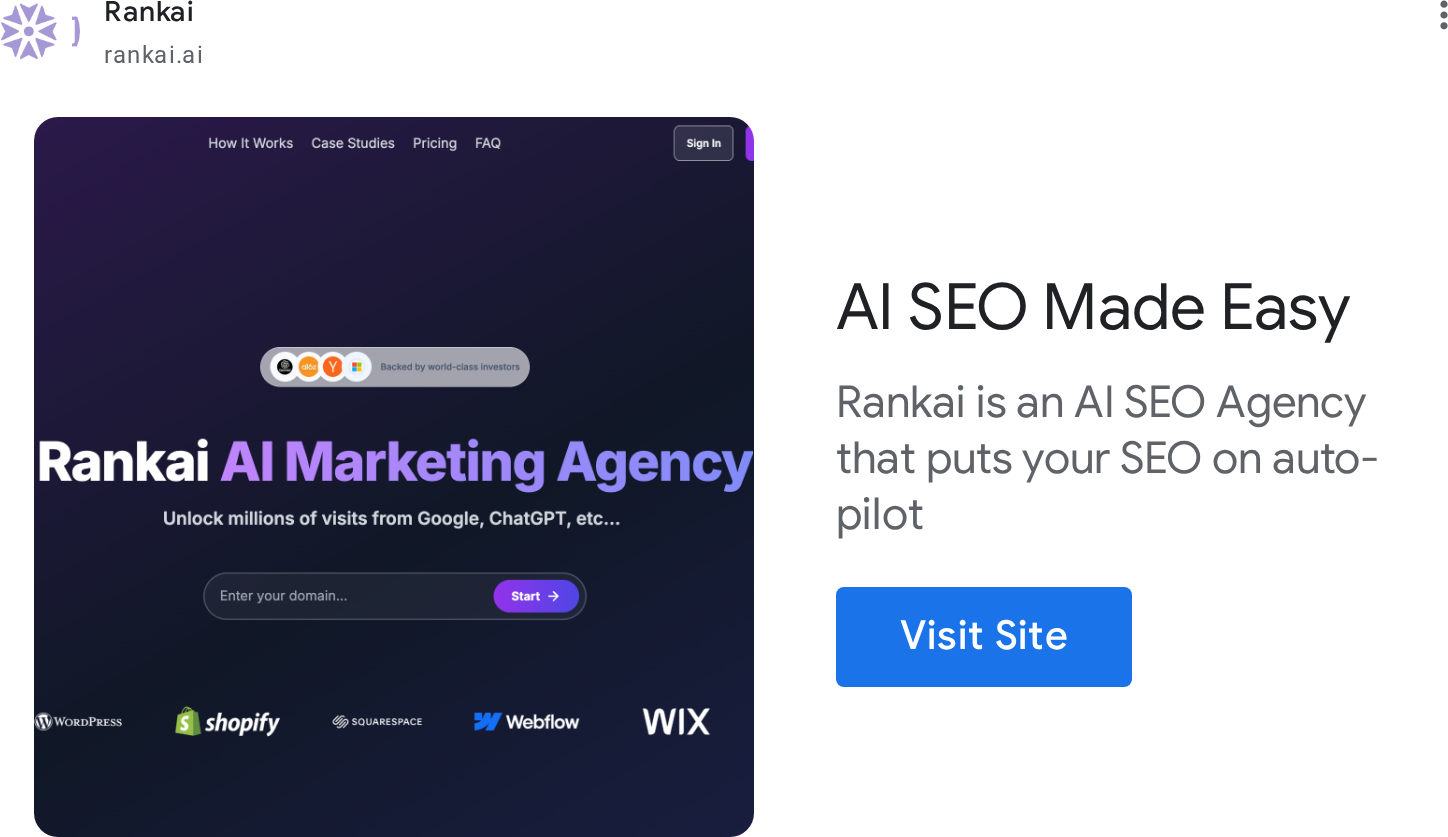
- Running
- 428 days (longevity = it's converting)
- Hook
- "Rankai" and a purple abstract logo on a white background, with "rankai.ai" below it. To the right, the text "AI SEO Made Easy" is visible.
- CTA / offer
- Visit Site
- Audience
- Businesses or individuals managing websites (WordPress, Shopify, Squarespace, Webflow, Wix users) who are looking for SEO solutions, specifically those interested in AI-driven tools.
Why it works. Targets non-technical founders intimidated by SEO jargon by promising simplicity rather than listing more features.
Headline and sub-headline directly state the problem and solution: "AI SEO Made Easy" and "Rankai is an AI SEO Agency that puts your SEO on auto-pilot." If your buyers find your category intimidating, pair the category name directly with a simplicity promise in three to four words.
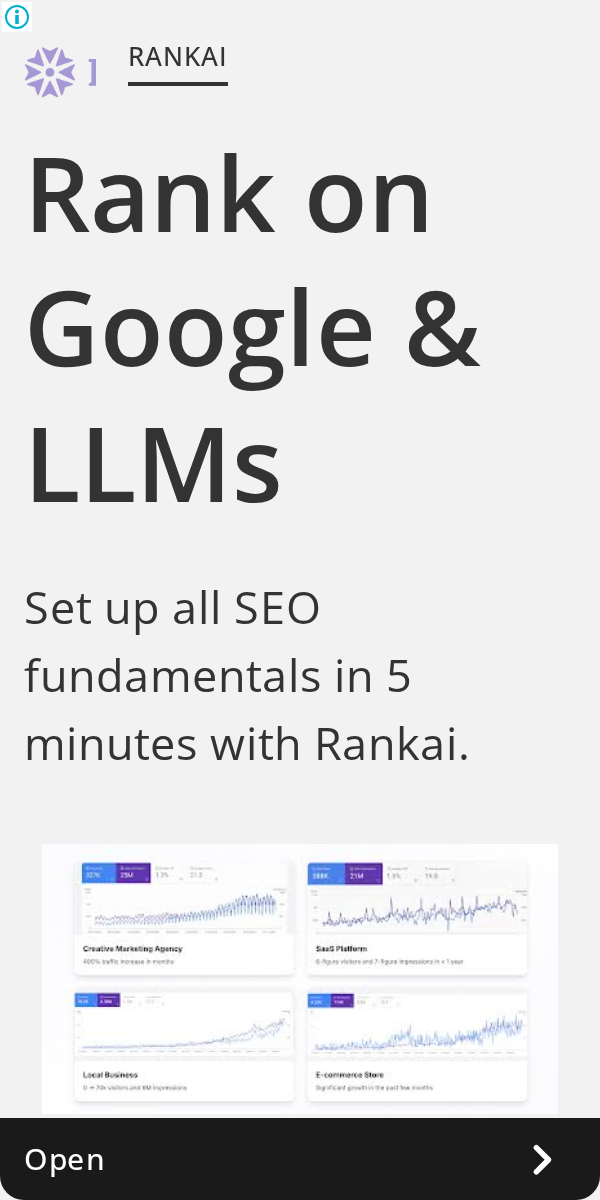
- Running
- 49 days (longevity = it's converting)
- Hook
- Visual: A purple, snowflake-like logo next to the word "RANKAI" with an underline. Text: "Rank on Google & LLMs".
- Audience
- Businesses and marketers interested in SEO and AI, indicated by terms like "Google & LLMs", "SEO fundamentals", "Creative Marketing Agency", "SaaS Platform", "Local Business", and "E-commerce Store".
Why it works. Captures both traditional SEO searchers and the newer AI-visibility audience with a single two-target headline.
Headline stating a clear benefit: "Rank on Google & LLMs". When your product spans an old and new version of a category, name both targets in one short headline instead of picking one.
Show 3 more ads
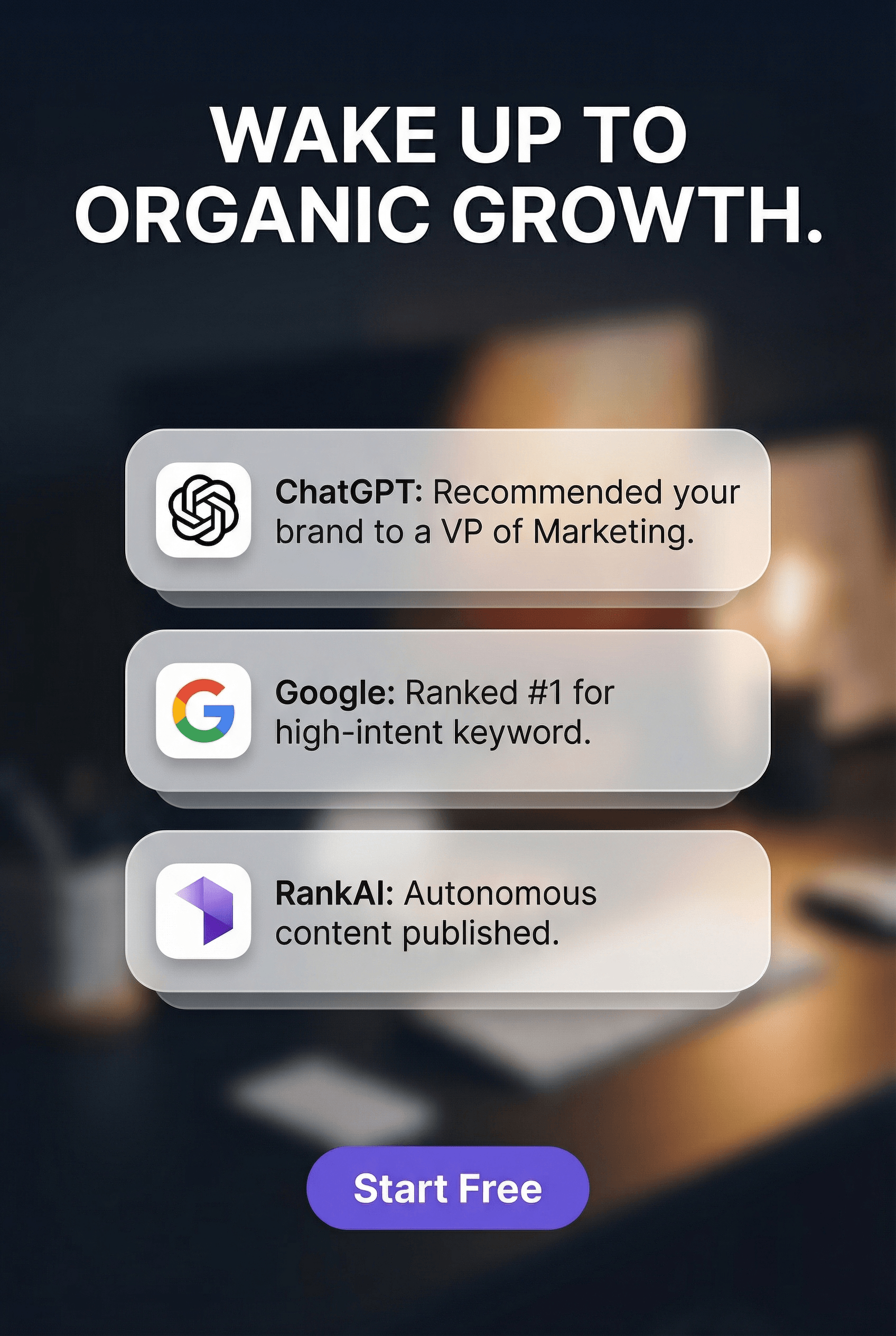
- Running
- 21 days (longevity = it's converting)
- Hook
- "WAKE UP TO ORGANIC GROWTH." on a dark, blurred background with a light source on the right.
- CTA / offer
- Start Free
- Audience
- Business owners, marketers, or individuals seeking to improve their online presence and growth, indicated by terms like "VP of Marketing," "high-intent keyword," and "organic growth."
Why it works. Implies the reader's current SEO is asleep without saying so directly, aimed at businesses with flat organic traffic.
Displaying specific, positive outcomes from well-known platforms: "ChatGPT: Recommended your brand to a VP of Marketing." "Google: Ranked #1 for high-intent keyword." "RankAI: Autonomous content published." Use a metaphor that implies your reader's current results are dormant or wasted, rather than stating the problem outright.
- Running
- 19 days (longevity = it's converting)
- Hook
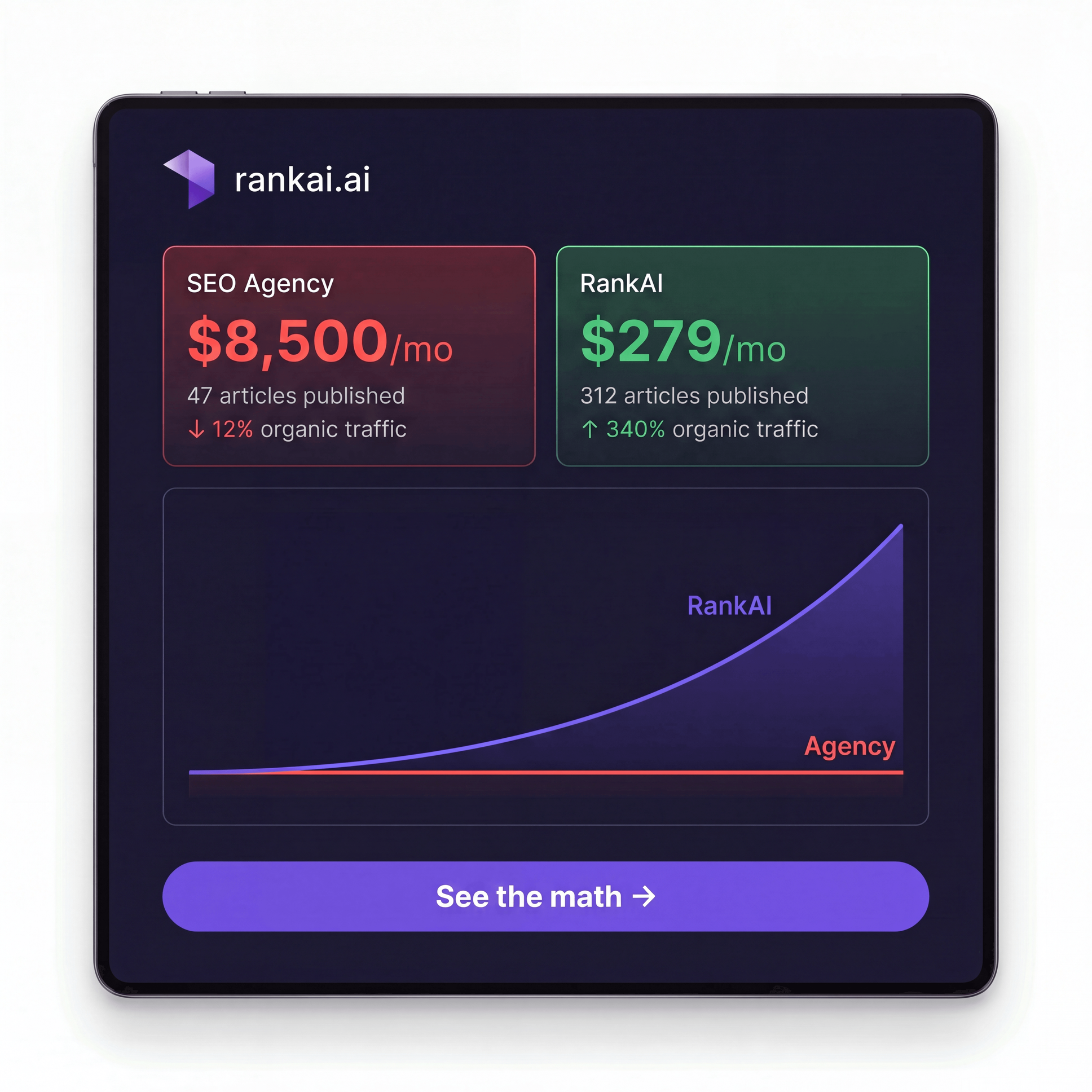
- The image displays a tablet screen with 'rankai.ai' at the top left, next to a purple geometric logo. Below this, two comparison boxes are visible: one red labeled 'SEO Agency' and one green labeled 'RankAI'.
- CTA / offer
- See the math →
- Audience
- Business owners or marketing managers concerned with SEO performance and budget, indicated by the direct comparison of 'SEO Agency' costs and results versus 'RankAI' costs and results.
Why it works. Puts a red-labeled SEO Agency box next to a green RankAI box so the cost comparison reads instantly without needing to read numbers first.
Direct cost comparison with 'SEO Agency' at '$8,500/mo' vs. 'RankAI' at '$279/mo'. Use color alone, red versus green boxes, to signal which option in your comparison graphic is the losing one before the reader reads a single number.
- Running
- 15 days (longevity = it's converting)
- Hook
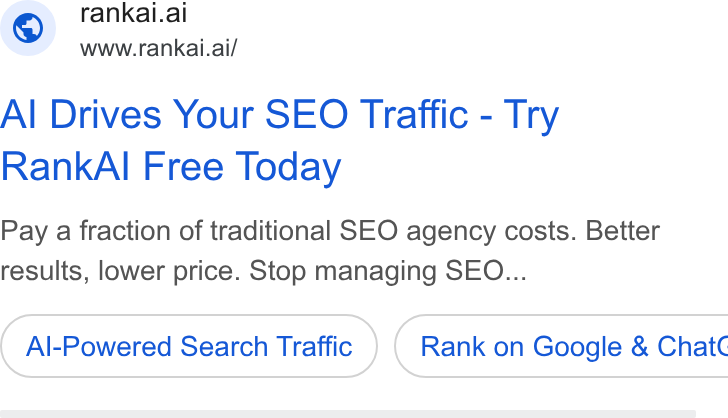
- On-screen text: "AI Drives Your SEO Traffic - Try RankAI Free Today". Visual: A blue globe icon next to "rankai.ai" and "www.rankai.ai/".
- CTA / offer
- Try RankAI Free Today
- Audience
- Businesses or individuals concerned with SEO, indicated by terms like "SEO Traffic", "SEO agency costs", and "Rank on Google & ChatG".
Why it works. Leads with the mechanism, AI driving traffic, before the brand name so skeptical clickers see the how before the who.
Headline with a bold claim and free offer: "AI Drives Your SEO Traffic - Try RankAI Free Today" Open your headline with the mechanism that produces the result, then name your product only in the second half of the line.
08 The playbook
The channels are not separate. They are one system where each stage feeds the next. Here is the read, then the plays to run tomorrow.
The inferred playbook
The loop starts with a proven-winner Google ad, converts through a free audit form, and compounds through content the product writes about itself, but nothing here builds a founder or community layer to make growth cheaper over time.
The recurring free "AI Search Visibility Audit" and "Free SEO Audit" offers mean paid spend is buying a specific next step for the visitor, not just brand exposure.
Ads advertise plans "starting at $69/mo" and a "$279/mo" tier, which sits close to the ~$284 blended ARPU across 166 subscriptions, suggesting most paying customers cluster near that mid-tier rather than the entry price.
Dig deeper+3▾
Just five organic pages pull measurable traffic, a small fraction of the total ~48,482 monthly visits, so the layer meant to eventually reduce paid dependence hasn't scaled yet.
With no founder-audience, no affiliate program, and no viral launch surfaced in the evidence, every dollar of growth outside the organic-search share still traces back to a media budget rather than a free multiplier.
free-to-paid conversion, churn, CAC, and confirmed pricing tiers (public ads show $69/mo and $279/mo price points, but RankAI has not published formal tiers on-site).
Chase the niche no one else wants
The proofTwo of RankAI's top organic pages target adult-industry SEO, a query space mainstream competitors avoid for brand-safety reasons, and one ranks #2 for that exact term.
The adaptationFind a subsegment of your market that competitors won't touch for reputational, regulatory, or effort reasons, and publish the definitive page for it before anyone else does. Start by listing five subsegments of your ideal customer that your top three competitors have zero content on, then write one page targeting the least-contested one.
Cost: $0 · Time to signal: weeks · Works pre-PMF: yes
Turn your product into a free diagnostic
The proofRankAI's recurring ad angle is a free "AI Search Visibility Audit" that scores a visitor's current state before pitching anything.
The adaptationBuild the smallest version of your product that scores or diagnoses a prospect's current situation in their own category, and put it behind a single ad or outbound message. Pick one metric your product improves and ship a one-page tool that scores it for free in under a minute.
Cost: under $500 · Time to signal: days · Works pre-PMF: yes, provided the diagnostic reveals a real gap the visitor cares about; a generic score with no actionable takeaway won't convert.
Let the product write its own marketing
The proofRankAI's top organic pages are produced by its own content-generation engine, so the blog doubles as a live demonstration of the tool working.
The adaptationIf your product creates or transforms an artifact, content, code, designs, reports, publish its actual output as marketing instead of writing separate copy about the product. Run your tool on a real, publicly relevant input and post the raw output as a page or thread, letting the artifact make the pitch.
Cost: $0 · Time to signal: weeks · Works pre-PMF: yes
Fund the ad that already works before you diversify
The proofRankAI's oldest active Google ad has run 433 days as of 2026-07-03, while its Meta ad batch is only weeks old, showing sustained budget goes to the channel with the longest track record before a second one gets added.
The adaptationOnce one paid angle keeps converting, even at small spend, keep it running unchanged instead of rotating creative for novelty, and only add a second platform after the first has a multi-month track record. Pick your single best-performing ad or post and commit a fixed weekly budget to it for at least a month before testing anywhere else.
Cost: under $5k · Time to signal: months · Works pre-PMF: no, this assumes existing paid budget and a channel already showing signal, not a pre-revenue starting point. Not transferable at an earlier stage: RankAI's year-plus Google ad budget and its 166-subscription base to reinvest assume revenue a pre-PMF founder doesn't have yet; treat Play 4 as where you're headed, not where you start.
You just read how RankAI does it. Tomorrow it is someone else.
Every morning we take one company that is actually growing and break down where its customers come from: the ads still running after a year, the channel doing the real work, and the play you can run this week.
Systemaic · directional intelligence. Traffic, spend, and reach figures are SimilarWeb-style estimates and qualitative reads of public data, not audited numbers. Built on real public receipts.
// teardowns with a similar GTM motion
sources & receipts (3)
Live ad libraries: meta ad library · google ad library
Launch archives: Hacker News: Show HN: Rankai – Automated SEO with AI
Traffic, spend, and revenue figures are estimates as noted in the report; the links above are the primary public artifacts.