- 01Turn your build log into your top-of-funnel
- 02Ship an experiment, then publish the delta
- 03Build a landing page for every rival platform your buyer already uses
- 04Write the page that ranks for a rival's pricing question
01 Snapshot
The one-glance read on who they are and how they grow. Each point is verifiable from the receipts above.
An AI customer-support agent that SaaS teams train on their own docs (Intercom, Freshdesk, Gorgias, Zendesk) to deflect tickets, built and run by co-founders Mike Heap and Alex Rainey with no other employees.
Founder-led and launch-led, with a recurring LinkedIn webinar funnel layered on top for enterprise buyers.
~32K monthly visits (+46.1% over the last 3 months), ~$25k MRR (~$300k/yr revenue on roughly $100/mo in ongoing infrastructure) as of its 2026 Starter Story feature (source), and founder X followings of 2,168 (Heap) and 1,431 (Rainey).
Their Google ads and organic pages target the identical set of rival help-desk brands (Freshdesk, Gorgias, Intercom's Fin), so paid and SEO compound the same competitor-conquest keywords instead of splitting attention across generic terms.
02 How it unfolded
The order the channels came online. Sequence is strategy: what they did first, and what they layered on once demand existed.
03 Traffic & channel mix
Estimated demand, the channel split behind it, and the keywords and referrers doing the work. Directional modeling, not audited analytics.
Traffic sources
Top search keywords
| Keyword | Volume | Weight | CPC |
|---|---|---|---|
| my askai | 450 | - | |
| askai | 4.6k | $0.68 | |
| myaskai | 120 | $4.42 | |
| yuma ai cost | 80 | - | |
| my.ask | 400 | - |
Closest competitors by audience
My AskAI draws an estimated 32,000 monthly visits across all channels, up 46.1% over the last 3 months. Direct traffic dominates at 60.6% of the mix, consistent with a base of returning users and founder-driven referrals typing the URL directly rather than discovering it fresh. Organic search follows at 21%, and organic social sits at 12.3%, together confirming the report's read that this company grows on content and personal-brand distribution rather than paid reach. Gen AI referrals already register at 3.9%, an early but real signal of AI-chat-driven discovery for a company this size, while referral links trail at 2.2%.
Their highest-volume ranking/bidding term is "askai" at 4,630 searches/mo, a generic category term well beyond their own brand name. Branded terms "my askai" (450/mo) and "myaskai" (120/mo) show a smaller but captive branded-search base, and "yuma ai cost" (80/mo), a rival AI tool's pricing query, shows the same rival-pricing-capture instinct visible in their own blog content below.
Three competitors stand out: intercom.com, the incumbent help-desk platform whose AI add-on Fin is the direct target of their ad copy and integration pages; docs.gorgias.com, Gorgias's own documentation surfacing as a competitor, confirming overlap in the e-commerce support-integration search space; and a cluster of similarly-named rivals (ask-ai.com, askaichat.app, iask.ai), a naming-collision risk in a crowded "AskAI"-branded niche.
04 Organic content
The specific pages earning their organic search traffic, and the pattern behind why they rank. Adapt the format, not the topic.
Their top organic pages split between definitional glossary content and competitor-integration landing pages. The homepage captures the largest share of organic entries (~139 visits/mo, 47% of the total), followed by a "what is a chatbot" explainer (~41 visits/mo) that ranks for the broad, top-of-funnel query "chatbot meaning" (#15), and a long-form guide to Ada, a rival AI-agent vendor. A Freshdesk integration page and a post titled "Crisp pricing explained," which breaks down a competitor's pricing rather than their own, round out the top five. The pattern reads as intentional: intercept buyers while they're still researching a category or a specific rival, before they've picked a vendor to review.
Top pages by organic traffic
05 Channel map
Not traffic share. How much weight the growth system actually puts on each channel, with a one-line read on the role it plays.
What drove growth
06 The motions doing the work
For founder-led SaaS the breakdown shifts from ads to traction: where the first users came from, how the founder grows it in the open, and the compounding organic surface.
My AskAI's early growth ran through a single Product Hunt launch amplified almost entirely by the founders' own X accounts, then an inbound media feature that validated the product to a much larger audience.
On February 21, 2023, Mike Heap launched My AskAI on Product Hunt with a build-in-public-tagged post that pulled 134 likes and 42,900 views on X, the single highest-engagement tweet in the founders' archive.
By June 1, 2023, HubSpot invited My AskAI onto its "AI Shark Tank" segment on the Marketing Against the Grain podcast, an inbound feature the founders attribute directly to their public building.
Dig deeper+2▾
On April 17, 2024, the founders returned to Product Hunt with a narrower pitch, an Intercom integration priced roughly five times cheaper than Intercom's own Fin, treating a feature ship as a fresh launch moment rather than a one-time event.
Revenue moved from roughly $14K MRR at around 300 users, per Heap's own Indie Hackers account of 2023, to "over $325k" in total revenue by February 13, 2024, per his own tweet.
Both founders treat their personal X accounts as the primary distribution channel, using them to narrate numbers, UX experiments, and community appearances rather than routing activity through the brand account.
Heap (@mike_heap_, 2,168 followers, 7,915 posts) runs the numbers-and-lessons thread, while Rainey (@raineyallday, 1,431 followers, 1,817 posts) runs tactical UX-experiment posts and community appearances; the brand account (@usemyaskai, linked from the homepage) carries none of the scraped posting activity itself.
Heap's January 8, 2024 "11 lessons" thread (115 likes, 22,963 views) doubles as an Indie Hackers post (source), naming directory listings, replying to AI-influencer accounts, and newsletter placements as tactics whose returns decayed fast once they became popular.
Dig deeper+2▾
Rainey's January 12, 2024 post reported a 40% conversion lift from defaulting new users onto the free plan and routing them to an Insights Dashboard instead of a plan-choice screen, a concrete UX change shared with the metric attached.
Rainey hosted a live AMA in the 70,000-member r/SaaS community on October 24, 2023, extending the same build-in-public voice onto a second platform rather than maintaining an ongoing subreddit presence.
Organic search accounts for 21% of the channel mix, and the system behind it stacks glossary content, competitor-integration pages, and a formal affiliate program rather than relying on domain authority alone.
The glossary and comparison pages covered above exist to intercept broad, top-of-funnel searches before a buyer has picked a vendor, a lower-competition target than bidding on "AI customer support" outright.
The Freshdesk page ranks organically (#7 for "freshdesk ai") for the same rival platforms, Freshdesk, Gorgias, and Intercom's Fin, that the Google ad creatives target directly ("My AskAI - AI for Freshdesk and Freshchat," "AI agent in Gorgias"), so paid and organic point at the identical keyword set instead of splitting effort across generic terms.
Dig deeper+2▾
A proven-winner Google ad line, "Stick with Intercom, ditch Fin," names the incumbent by product to catch bottom-funnel switchers, while the LinkedIn flight opens on a mocked-up Slack message from "Sarah J., CEO" asking "can you look into AI for support," a curiosity hook that role-plays the exact internal conversation its target buyer is already having.
The Rewardful-powered program, covered above, pays outside promoters to send signups, though no evidence shows its current recruiting scale or payout structure.
07 Paid ads
This founder-led SaaS also runs paid acquisition. Here are the live ads doing the work, each with the X-ray and a play you can adapt.
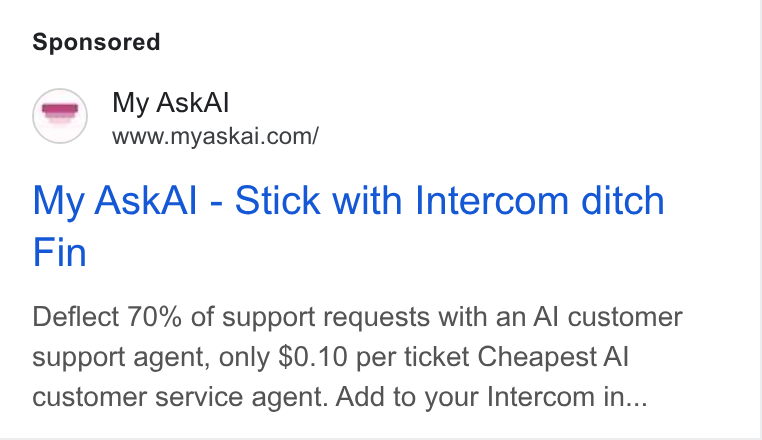
- Running
- 99 days (longevity = it's converting)
- Hook
- My AskAI - Stick with Intercom ditch Fin
- CTA / offer
- Deflect 70% of support requests with an AI customer support agent, only $0.10 per ticket Cheapest AI customer service agent. Add to your Intercom in...
- Audience
- Businesses using or considering Intercom for customer support, indicated by the direct mention of 'Intercom' and 'Fin' (a known competitor in the AI customer service space).
Why it works. Targets Intercom plus Fin users by name and offers a lower-risk swap: keep the helpdesk, replace only the AI agent inside it.
Direct competitor comparison in headline: "My AskAI - Stick with Intercom ditch Fin" Name a competitor's specific feature in your headline and tell prospects exactly what to keep and what to replace.
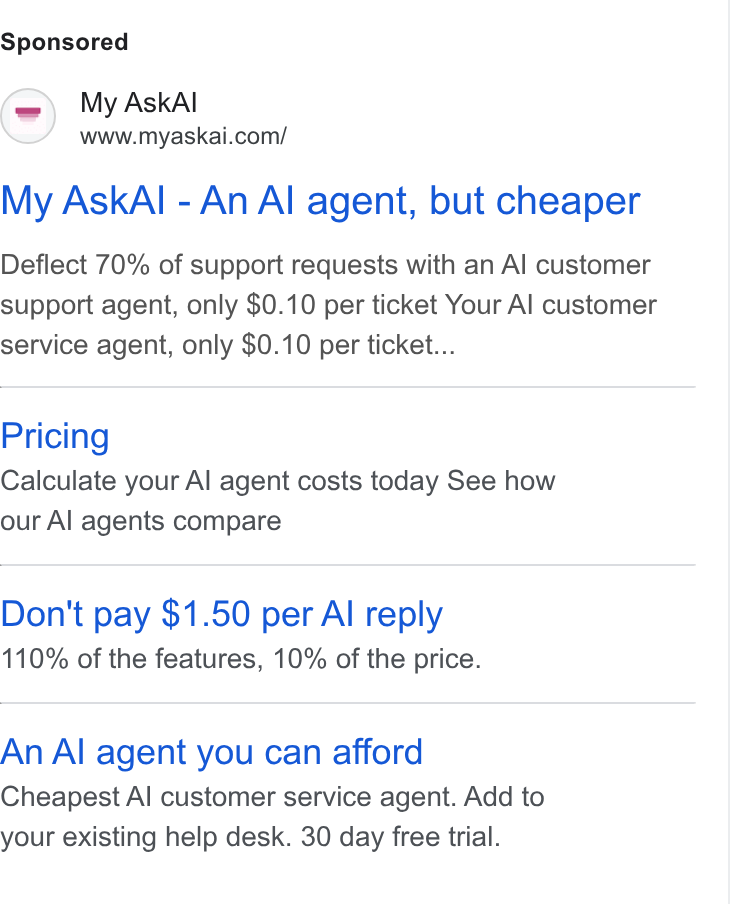
- Running
- 99 days (longevity = it's converting)
- Hook
- My AskAI - An AI agent, but cheaper
- CTA / offer
- 30 day free trial.
- Audience
- Businesses seeking cost-effective customer support solutions, indicated by phrases like "support requests," "customer service agent," and pricing comparisons.
Why it works. Uses blunt, self-deprecating phrasing to frame the product as the value pick against pricier AI agents, appealing to cost-conscious buyers.
Headline with a direct cost comparison: "My AskAI - An AI agent, but cheaper" Pair your product category with a one-word price contrast (cheaper, faster, simpler) instead of a full value proposition.
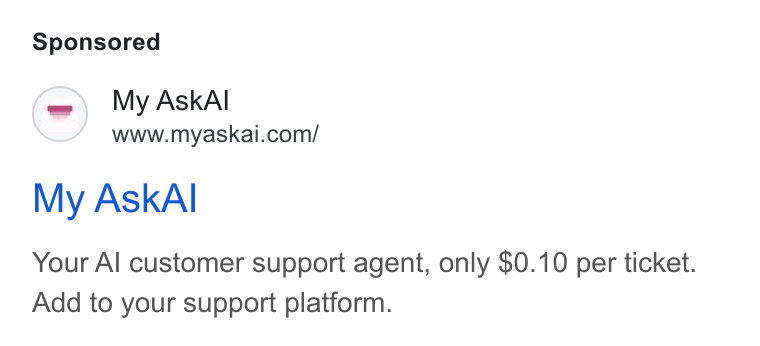
- Running
- 98 days (longevity = it's converting)
- Hook
- Sponsored My AskAI www.myaskai.com/ My AskAI Your AI customer support agent, only $0.10 per ticket. Add to your support platform.
- CTA / offer
- Your AI customer support agent, only $0.10 per ticket. Add to your support platform.
- Audience
- Businesses or individuals managing customer support, indicated by the offer of an "AI customer support agent" and the call to "Add to your support platform."
Why it works. Replaces vague cost-savings talk with a literal per-ticket price, giving support leads a number they can plug straight into their own volume.
Headline and description state a specific, low price point: "Your AI customer support agent, only $0.10 per ticket." Convert your pricing into the smallest unit your buyer already measures (per ticket, per seat, per lead) and put that number in the headline.
Show 2 more ads
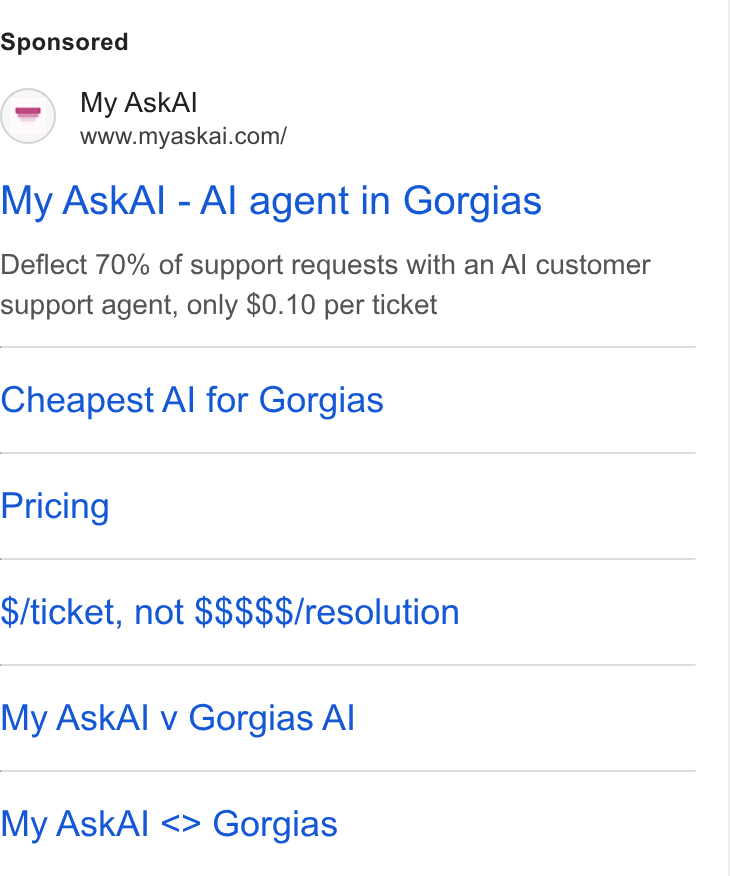
- Running
- 74 days (longevity = it's converting)
- Hook
- Sponsored My AskAl www.myaskai.com/ My AskAl - Al agent in Gorgias
- CTA / offer
- Deflect 70% of support requests with an Al customer support agent, only $0.10 per ticket
- Audience
- Businesses using or considering Gorgias for customer support, specifically those looking to reduce support costs and improve efficiency. This is signaled by direct mentions of "Gorgias" and "support requests."
Why it works. Targets Gorgias merchants specifically by naming the platform they already use, positioning the product as a plug-in rather than a switch.
State a specific, quantifiable cost benefit upfront: "Deflect 70% of support requests with an Al customer support agent, only $0.10 per ticket" If you integrate with a specific platform, put that platform's name directly in your headline to filter in existing users.
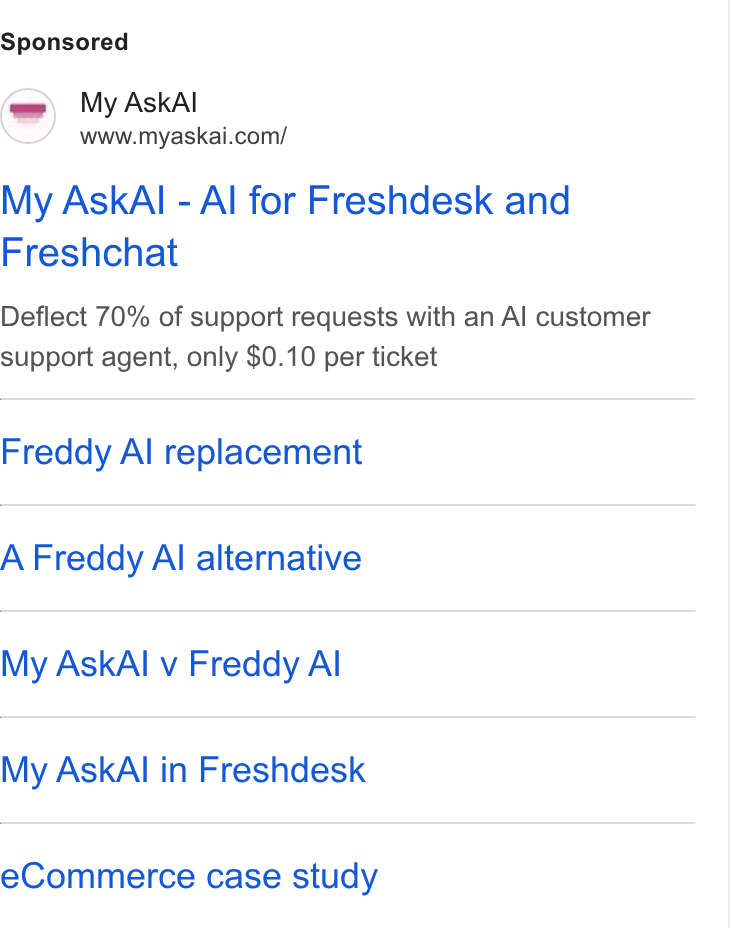
- Running
- 73 days (longevity = it's converting)
- Hook
- Sponsored My AskAI www.myaskai.com/ My AskAI - AI for Freshdesk and Freshchat
- CTA / offer
- Deflect 70% of support requests with an AI customer support agent, only $0.10 per ticket
- Audience
- Businesses using Freshdesk or Freshchat, or those looking for AI customer support solutions, indicated by the direct mention of these platforms and the competitive comparison to 'Freddy AI'.
Why it works. Targets Freshdesk and Freshchat users precisely by naming their existing tools in the headline instead of speaking to support teams generically.
Headline directly names the product and its core function: "My AskAI - AI for Freshdesk and Freshchat" Name the exact platform or tool your product plugs into in the headline so users of that tool self-select.
08 The playbook
The channels are not separate. They are one system where each stage feeds the next. Here is the read, then the plays to run tomorrow.
The inferred playbook
The loop starts with a founder posting a hard number on X, converts through a low-friction trial, and compounds through glossary and integration SEO while the LinkedIn webinar funnel works the enterprise end on its own track.
A founder tweet with a concrete number, the 42,900-view Product Hunt post or the "11 lessons" thread covered above, still functions as the top of funnel more than any paid channel.
A 30-day no-card trial feeds a usage-based ladder: $199/mo Pro for 1,000 conversations, up to $499/mo Scale for 2,000 conversations plus SOC 2 Type II and white-label, and custom Enterprise from $999/mo, so ARPU scales with support volume rather than seats.
Dig deeper+3▾
The glossary and integration pages under Content & SEO Engine keep earning organic visits long after a given tweet stops circulating, the only channel in the mix that doesn't need continuous founder attention.
With ~32K monthly visits and two full-time founders, there's no visible content or community team behind the SEO or LinkedIn programs, so both scale only as far as the founders' own bandwidth allows.
free-to-paid conversion rate, churn, CAC, and current affiliate-program payout or recruiting scale.
Turn your build log into your top-of-funnel
The proofHeap's launch tweet and "11 lessons" thread pulled 42,900 and 22,963 views respectively, among the highest-reach posts in the founders' own archive.
The adaptationPost your own launch and a first-year retrospective on your personal account with a specific number in the first line (users, revenue, a conversion lift), not a generic milestone announcement. The mechanism: a number-led post reads as a receipt, not marketing, so it gets shared and quoted past your existing followers. First step: draft one tweet naming your current MRR or user count and the single biggest lesson it took to get there, post it from your own handle, not the company's.
Cost: $0 · Time to signal: days · Works pre-PMF: yes
Ship an experiment, then publish the delta
The proofRainey's onboarding change, covered above, was shared as a dated post with the exact lift attached rather than a vague "we improved conversion" claim.
The adaptationPick one small friction point in your own signup flow, change it, measure the before/after over a fixed window, and post the specific percentage the day you have it. First step: audit your onboarding for the single screen with the highest drop-off, run one A/B test on it, and write the result as a two-sentence post whether the number is good or bad.
Cost: $0 · Time to signal: weeks (bounded by how long the test needs to run) · Works pre-PMF: yes
Build a landing page for every rival platform your buyer already uses
The proofThe Freshdesk integration page ranks organically for "freshdesk ai" and is expanded on in the paid layer above.
The adaptationList the 3-5 tools your ideal customer already has installed (a CRM, a help desk, a data source) and write one page per tool: "[Your product] for [Tool]," covering the specific integration and workflow. First step: pick the single most common tool in your customers' stack and publish one page naming it in the URL and H1.
Cost: under $500 (a freelance writer or your own time) · Time to signal: months (organic ranking lag) · Works pre-PMF: conditional, only once you have at least one real integration to describe accurately
Write the page that ranks for a rival's pricing question
The proofThe "Crisp pricing explained" post, covered above, targets buyers researching a competitor's cost rather than My AskAI's own brand terms.
The adaptationIdentify the two or three competitors your prospects compare you against and write an honest breakdown of each one's pricing and packaging, positioned as buyer research rather than a takedown. First step: pick your most-searched competitor, publish a page titled "[Competitor] pricing explained," and link to your own pricing page from it.
Cost: $0 · Time to signal: months (organic ranking lag) · Works pre-PMF: yes
Run ad flights, not always-on campaigns
The proofLinkedIn's webinar ad cycles in short 7-to-8-day bursts tied to a specific event date rather than running continuously, expanded as Play 3's targeting logic above.
The adaptationInstead of leaving a paid campaign running indefinitely, tie each flight to a dated event (a webinar, a launch, a feature release) and turn it off when the event passes, then relaunch a fresh flight around the next one. The mechanism: a dated event gives the ad copy urgency and gives you a natural stop-loss instead of bleeding budget on stale creative. First step: pick one upcoming date-bound event in your business and build a single ad around it with a hard end date.
Cost: under $500 for a first test flight · Time to signal: weeks · Works pre-PMF: no, this needs an existing funnel and a real event to anchor the ad to Not transferable at an earlier stage: the LinkedIn webinar funnel and the multi-page competitor-integration library both assume a working sales motion and enough integrations already built to write honestly about; a pre-product company should focus on Plays 1, 2, and 4 until those exist.
You just read how My AskAI does it. Tomorrow it is someone else.
Every morning we take one company that is actually growing and break down where its customers come from: the ads still running after a year, the channel doing the real work, and the play you can run this week.
Systemaic · directional intelligence. Traffic, spend, and reach figures are SimilarWeb-style estimates and qualitative reads of public data, not audited numbers. Built on real public receipts.
// teardowns with a similar GTM motion
sources & receipts (4)
Live ad libraries: linkedin ad library · google ad library
Launch archives: Hacker News: Show HN: AI Slack Assistant connected to G Drive and Notion · Hacker News: After 1k hours building AI chatbots, here’s why you shouldn’
Traffic, spend, and revenue figures are estimates as noted in the report; the links above are the primary public artifacts.