- 01Turn one customer's ROI into a thread
- 02Publish a milestone update at a fixed checkpoint
- 03Write the "best [category] tools" roundup for your own market
- 04Recruit tutorial creators through a simple affiliate page
01 Snapshot
The one-glance read on who they are and how they grow. Each point is verifiable from the receipts above.
A no-code, drag-and-drop platform for building AI agents and workflow automations for sales, marketing, and ops teams, born out of Y Combinator's Winter 2024 batch.
Founder-led, with a bottom-up product-led growth motion layered on top.
~701,000 estimated monthly visits (+61.1% over the last 3 months, as of 2026-07-05); founder Max Brodeur-Urbas's X following sits at 20,197; total funding reached ~$70.6M across four rounds, the latest a $50M Series B led by Benchmark in March 2026; the team grew to roughly 40 people by May 2026.
Google search ads live since 2026-06-18 bid on "Claude Enterprise alternative" and "Claude Cowork alternative" search terms, a direct conquest of Anthropic's own agent products.
Gumloop's paid spend is mostly a reach-extension layer for its own organic wins, not a demand-generation engine, its LinkedIn ad library is largely the founder's and employees' best-performing organic posts run as paid boosts rather than distinct ad creative.
02 How it unfolded
The order the channels came online. Sequence is strategy: what they did first, and what they layered on once demand existed.
03 Traffic & channel mix
Estimated demand, the channel split behind it, and the keywords and referrers doing the work. Directional modeling, not audited analytics.
Traffic sources
Top search keywords
| Keyword | Volume | Weight | CPC |
|---|---|---|---|
| gumloop | 83k | $1.95 | |
| best ai | 105k | $2.00 | |
| best free ai | 26k | $2.07 | |
| gumloop ai | 3.0k | $13.90 | |
| gumloop affiliate program | 1.1k | - |
Top referring sites
Closest competitors by audience
Gumloop draws an estimated ~701,000 monthly visits, up 61.1% over the last 3 months. Search Organic is the dominant channel at 47%, Direct follows at 33.4%, and Referrals sit at 7.9%, together carrying the large majority of traffic. The rest, social organic, email, generative-AI referrals, paid search, display, and paid social, totals just under 12% combined.
The brand term "gumloop" pulls ≈82,900 monthly searches, but the site also competes for two much larger unbranded head terms it targets through content: "best ai" (104,500/mo) and "best free ai" (26,440/mo). A smaller but telling query, "gumloop affiliate program" (≈1,100/mo), points to real interest in its creator/partner track.
Top referrers include feishu.cn (a Chinese enterprise collaboration suite, plausibly workflow links shared inside customer teams like Shopify or Instacart), saaslandingpage.com (a landing-page inspiration gallery, meaning other builders are studying Gumloop's site rather than converting), and luma.com (its own event platform, tying back to the workshop invites Gumloop runs). Its closest competitors by traffic overlap are n8n.io, lindy.ai, and vellum.ai, all direct AI-workflow or agent-building rivals, while firecrawl.dev and scrapeops.io in the same list are scraping-infrastructure tools more likely to be complements than head-to-head competitors.
04 Organic content
The specific pages earning their organic search traffic, and the pattern behind why they rank. Adapt the format, not the topic.
Gumloop's organic traffic concentrates almost entirely in "best AI tool" roundup pages: a single page, /blog/best-ai-apps, drives an estimated ~84,200 organic visits/month, 54.4% of the organic traffic captured at the page level by the SEO tool (a narrower scope than the site-wide channel-mix estimate above, so treat it as the share among ranked pages, not of all organic sessions), with three more roundups ("best ai workflow automation tools," "best marketing automation platforms," "best ai web scrapers") and the homepage rounding out the top five.
The pattern is a classic top-of-funnel comparison strategy: broad, non-branded "best X tools" listicles built around massive generic search volume ("best ai" alone pulls 104,500 searches/month across the web) rather than narrow product or docs pages. These pages rank because they satisfy category-level buyer intent ("give me the whole list") and let Gumloop position itself credibly alongside competitors it's also being compared to elsewhere. The tradeoff is concentration risk: one page carries more than half the organic load, so the strategy is really one format, replicated a handful of times, rather than a broad content moat.
Top pages by organic traffic
05 Channel map
Not traffic share. How much weight the growth system actually puts on each channel, with a one-line read on the role it plays.
What drove growth
06 The motions doing the work
For founder-led SaaS the breakdown shifts from ads to traction: where the first users came from, how the founder grows it in the open, and the compounding organic surface.
Gumloop's early traction ran through the YC pipeline and the founder's own viral tweets, not a coordinated Product Hunt or Hacker News launch spike.
On day 80 of the YC W24 batch, Max Brodeur-Urbas posted a public results update, MRR up 4,100% and daily automation runs up 650% since the batch started, turning an accelerator milestone into a credibility-building broadcast.
A 2024-06-11 tweet describing a YC batchmate's intern building in two hours what a consultant quoted at $16,000 became Gumloop's single highest-reach organic moment, 3,468 likes and over 1M views, a customer-savings story rather than a launch announcement.
Dig deeper+2▾
Five submissions between November 2024 and June 2025 touched on Gumloop, including a third party's own Show HN for a tool built on top of it, but none topped 3 points, so HN never became a real acquisition channel despite repeated exposure.
A 2025-04-07 tweet describes Instacart's adoption starting from a single free-tier user who shared workflows internally until 1,000+ employees across 10 departments were building on Gumloop, the clearest evidence of how expansion actually happens inside enterprise accounts.
Gumloop's build-in-public motion runs almost entirely through one person, co-founder and CEO Max Brodeur-Urbas, on his personal X account, with co-founder and CTO Rahul Behal maintaining a much smaller parallel presence.
Brodeur-Urbas (20,197 followers, 816 posts) mixes metric milestones, viral customer stories, and thought-leadership calls, including a 2025-05-23 post arguing "no-code" as a category won't survive the next six months, and a 2025-08-19 post marking Shopify's shift from customer to investor.
His 2026-03-12 tweet announcing the $50M Series B, paired with a video, pulled 1,149 likes and 320,066 views, solid reach but well below the invoice-processor thread's peak.
Dig deeper+2▾
Rahul Behal runs his own account (4,142 followers, 797 posts) explicitly tied to Gumloop in his bio, but no individual post of his surfaced prominently in this evidence, making him a supporting voice rather than a second primary channel.
Several of the founder's and employees' organic LinkedIn posts, including hiring calls and workshop invites, later reappear as paid-boosted ads, blurring the line between the build-in-public feed and the paid motion (detailed below).
Search organic is Gumloop's single largest acquisition channel at 47% of all traffic, meaning the roundup-page strategy covered above is carrying real volume rather than vanity rankings.
Gumloop also runs a structured "University" course (lessons on flows, triggers, and subflows) and a public template library, both low-cost-to-produce surfaces that extend the same organic footprint into product-adjacent, evergreen content.
A Rewardful-powered partner program recruits creators directly (gumloop.com/partners/apply-to-be-a-creator), which likely explains the steady search demand for "gumloop affiliate program" and feeds the tutorial-style creator UGC seen on TikTok and Instagram.
Dig deeper+2▾
50 total ads, 5 active as of 2026-07-05; the longest-running active ad (~89 days) is generic category-capture copy ("Gumloop: Automate Anything"), while the newest active tests, live since 2026-06-18, bid directly on "Claude Enterprise alternative" and "Claude Cowork alternative," a defensive keyword grab against Anthropic's own products rather than broad demand generation.
An estimated 89-ad library (24 sampled, all active) leans heavily on dogfooding creative, one ad shows a founder-to-camera demo asking his own agent to "email me a report of all our paid and organic growth metrics" every morning, and another is an employee testimonial from an executive assistant contrasting a "6 months to learn their exec's world" baseline against instant AI ramp-up, both reused organic-style stories rather than agency-produced ads.
07 Paid ads
This founder-led SaaS also runs paid acquisition. Here are the live ads doing the work, each with the X-ray and a play you can adapt.
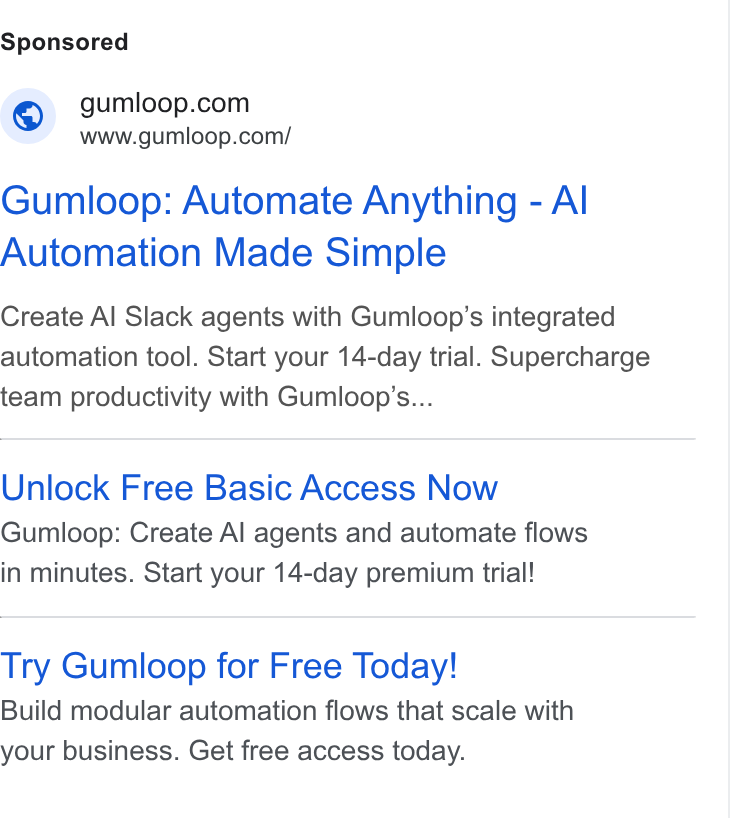
- Running
- 64 days (longevity = it's converting)
- Hook
- Visual: The word "Sponsored" at the top left, followed by a blue globe icon and the text "gumloop.com" and "www.gumloop.com/". Text: "Gumloop: Automate Anything - Al Automation Made Simple"
- CTA / offer
- 14-day trial, Free Basic Access, Free access today
- Audience
- Businesses or individuals looking to automate tasks and improve productivity, specifically mentioning "Al Slack agents" and "team productivity".
Why it works. Combines a maximalist scope claim with a simplicity claim so the ad answers both can it do X and is it hard to learn.
Headline with a broad, bold claim: "Gumloop: Automate Anything - Al Automation Made Simple" Pair a scope claim about what it can automate with an ease claim about how simple it is, in the same headline.
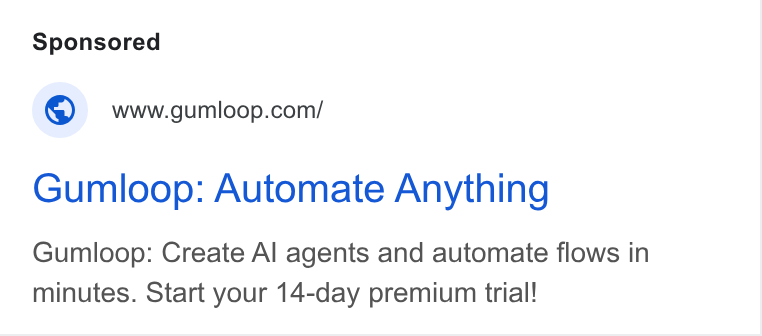
- Running
- 64 days (longevity = it's converting)
- Hook
- Sponsored, with a small globe icon and the URL "www.gumloop.com/" below it. The main headline is "Gumloop: Automate Anything".
- CTA / offer
- 14-day premium trial
- Audience
- Individuals or businesses looking to streamline operations and save time, indicated by the phrases "Automate Anything" and "Create AI agents and automate flows in minutes."
Why it works. An open-ended scope claim lets each searcher project their own automation need onto the product before they even click.
Lead with a strong, benefit-oriented headline: "Gumloop: Automate Anything" Test a headline that names your product plus one unbounded claim like Automate Anything, against a specific-use variant.
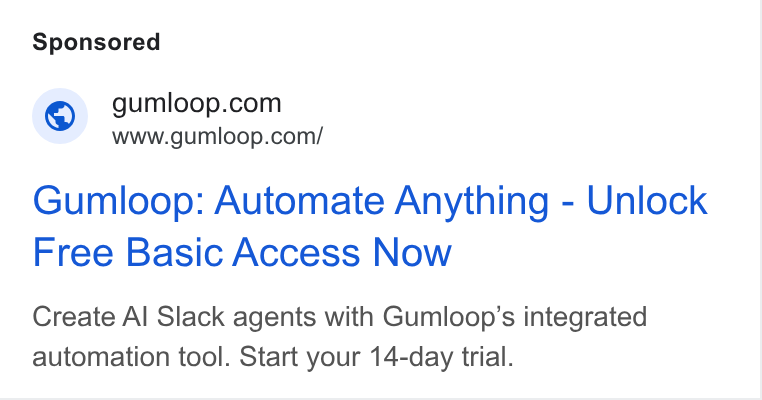
- Running
- 64 days (longevity = it's converting)
- Hook
- Sponsored gumloop.com www.gumloop.com/ Gumloop: Automate Anything - Unlock Free Basic Access Now
- CTA / offer
- Free Basic Access Now
- Audience
- Individuals or businesses looking to automate tasks, specifically mentioning 'AI Slack agents' and 'automation tool'.
Why it works. Pairs an unbounded capability claim with a free, no-commitment offer so curiosity has an immediate low-risk outlet.
Headline stating a broad benefit and immediate free access: "Gumloop: Automate Anything - Unlock Free Basic Access Now" End your headline with a specific free-tier action right after your core capability claim.
Show 3 more ads

- Running
- 64 days (longevity = it's converting)
- Hook
- Sponsored www.gumloop.com/ Automated Content Monitoring
- CTA / offer
- Start your 14-day premium trial!
- Audience
- Businesses or individuals interested in content strategy and AI, evidenced by the text 'Build AI Agents to power your content strategy'.
Why it works. A narrow use-case headline outperforms broad category terms for searchers who already know the specific job they need done.
Clear value proposition in the headline: 'Automated Content Monitoring'. Write a headline naming one narrow job your tool does, not your product category, to match specific-intent searches.

- Running
- 64 days (longevity = it's converting)
- Hook
- Sponsored gumloop.com www.gumloop.com/ Create AI Agents for Business - Free 14-Day Trial For Teams
- CTA / offer
- Free 14-Day Trial For Teams
- Audience
- Businesses and teams looking to integrate AI into their operations, evidenced by 'AI Agents for Business' and '14-Day Trial For Teams'.
Why it works. Bundles product, audience, and offer length into a single headline, letting a team buyer qualify themselves in one scan.
Headline clearly states the offer and benefit: 'Create AI Agents for Business - Free 14-Day Trial For Teams'. Combine what you build, who it's for, and your trial length into one headline instead of spreading them across separate lines.

- Running
- 64 days (longevity = it's converting)
- Hook
- Gumloop logo (pink 'G' in a circle) next to the word "Gumloop" and the URL "www.gumloop.com/". Below this, the blue text "Track Task Progress with AI".
- CTA / offer
- Start your 14-day premium trial!
- Audience
- Individuals or businesses looking to improve task management and leverage AI, indicated by "Build AI agents to manage and track daily tasks."
Why it works. Targets a specific management pain, tracking task progress, that's easy to picture solved, rather than pitching automation abstractly.
Headline as a bold claim: "Track Task Progress with AI" Pick one recurring, mundane task your buyer manually tracks and name it directly in your headline instead of your broader category.
08 The playbook
The channels are not separate. They are one system where each stage feeds the next. Here is the read, then the plays to run tomorrow.
The inferred playbook
Gumloop's loop starts with founder-driven virality and SEO reach, converts through free-tier self-serve, and compounds through seat expansion inside enterprise accounts rather than a repeatable paid channel.
The founder's viral X threads and the "best ai" roundup pages covered above are the two real top-of-funnel entries, one running on personal reach, the other on search volume.
Free-tier signups land inside individual departments, then spread seat-by-seat without a sales-led push, the same shape visible in the Instacart story covered above and in enterprise logos like Shopify, Webflow, Ramp, Gusto, Samsara, Rippling, and Opendoor.
Dig deeper+3▾
The organic engine's revenue is concentrated in one roundup page (covered above), and the paid motion is mostly a reach-extension of organic content rather than an independent acquisition source, so two of Gumloop's three engines are really extensions of the first.
There's no evidence of the founders running their own Reddit or Show HN presence, the classic indie-hacker launch channels never got worked directly, community-style discovery instead flows through third-party TikTok and Instagram creators rather than founder-owned community posts.
free-to-paid conversion rate, churn, CAC, and blended ARPU beyond list price. Third-party estimates (unverified) put ARR near $1.1M in 2025, likely dated given the unsolicited $50M Series B that followed in March 2026 on the back of surging enterprise demand.
Turn one customer's ROI into a thread
The proofThe invoice-processor thread covered above turned a single user's before/after cost story into Gumloop's highest-reach organic moment.
The adaptationFind one user in your own product who replaced an expensive manual process or vendor quote with something built in minutes, get the specific dollar figure and time saved, and post it from your personal founder account, not the brand account, framed as "here's what X used to cost, here's what one user built instead." The specificity of the before/after numbers is what makes strangers share it rather than scroll past.
Cost: $0 · Time to signal: days · Works pre-PMF: yes, provided you have at least one real user story with a concrete number attached.
Publish a milestone update at a fixed checkpoint
The proofGumloop's day-80 YC update covered above turned specific percentage growth into a public, credibility-building post.
The adaptationPick a recurring checkpoint, day 30 of a beta, week 12 of building, and post the real percentage change in a metric that matters (signups, usage, revenue) rather than a vague "things are going well" update. Post it as a numbered series so followers start expecting the next one.
Cost: $0 · Time to signal: days to weeks · Works pre-PMF: yes.
Write the "best [category] tools" roundup for your own market
The proofThe roundup pages covered above carry the large majority of Gumloop's organic traffic, concentrated in one page.
The adaptationIdentify the highest-volume generic buyer-intent term in your category (not your brand name) and write an honest, well-structured comparison post that includes your own product alongside real competitors. List real pros and cons for each entry, credibility is what gets it shared and linked, which is what makes it rank.
Cost: $0-500 (your time or a freelance writer) · Time to signal: months · Works pre-PMF: conditional, only pays off if your category has genuine, searchable demand behind the term you pick.
Recruit tutorial creators through a simple affiliate page
The proofGumloop's Rewardful-powered partner program feeds the tutorial-style creator UGC seen on TikTok and Instagram.
The adaptationStand up a basic affiliate program (Rewardful or similar takes an afternoon), then directly message 10-20 creators who already make how-to content in your space, offering a revenue share for a tutorial video that features your product solving a real task. Creators need a concrete demo-able workflow to film, not just an account to promote.
Cost: under $500 (affiliate tool plus first payouts) · Time to signal: weeks · Works pre-PMF: conditional, you need a product concrete enough to demo in one sitting.
Boost your best organic post instead of briefing new ad creative
The proofGumloop's LinkedIn ad library (covered above) is largely boosted versions of founder and employee organic posts, not separate agency creative.
The adaptationAfter you post something organically that outperforms your usual engagement, whether it's a milestone update, a customer story, or a dogfooding demo, put a small paid budget behind that exact post rather than commissioning new ad creative from scratch. The mechanism: a post that already proved it resonates organically is a far safer paid bet than an untested ad concept.
Cost: under $500 · Time to signal: days to weeks · Works pre-PMF: yes, as long as you have at least one organic post with real engagement to boost. Not transferable at an earlier stage: the founder's 20,197-follower X audience and the Benchmark-led investor interest behind the Series B are compounding advantages built over roughly two years. A first-time founder starts the viral-thread and roundup-page plays from zero audience and zero ranking authority, and should expect months of compounding before either produces anything close to Gumloop's current reach.
You just read how Gumloop does it. Tomorrow it is someone else.
Every morning we take one company that is actually growing and break down where its customers come from: the ads still running after a year, the channel doing the real work, and the play you can run this week.
Systemaic · directional intelligence. Traffic, spend, and reach figures are SimilarWeb-style estimates and qualitative reads of public data, not audited numbers. Built on real public receipts.
// teardowns with a similar GTM motion
sources & receipts (8)
Live ad libraries: linkedin ad library · google ad library
Launch archives: Hacker News: Once a sideproject, Gumloop's $17M Series A · Hacker News: I vibe coded Gumloop in a weekend · Hacker News: Show HN: Skyrim like skilltree for gumloop's AI automations · Hacker News: AI Generated Evaluation of an RFP Built with Lovable/Gumloop · Hacker News: Gumloop Founders Make a Magical App – Turning Everyone into · Hacker News: Open-source MCP servers for every app
Traffic, spend, and revenue figures are estimates as noted in the report; the links above are the primary public artifacts.