- 01Let your buyers find you in their own shortlist threads
- 02Collapse your pricing into one plan with a no-card trial
- 03Turn your loudest fans into a recruited affiliate force
- 04Bid on your own brand name once people start searching for it
01 Snapshot
The one-glance read on who they are and how they grow. Each point is verifiable from the receipts above.
An AI platform that generates and bulk-launches Meta ad creatives and campaigns for performance marketers and e-commerce teams.
Organic-led, with peer word-of-mouth inside advertiser communities substituting for a paid-acquisition or founder-personality engine.
$30,004 MRR (publicly reported) across 182 paying subscriptions, a ~$165 blended ARPU, and ~83,000 monthly visits, up 96.5% over the last three months as of 2026-07-06.
Growth runs on other advertisers vouching for AdStellar inside their own marketing communities, with SEO and an affiliate program compounding underneath, rather than paid media or a founder's personal following.
02 How it unfolded
The order the channels came online. Sequence is strategy: what they did first, and what they layered on once demand existed.
03 Traffic & channel mix
Estimated demand, the channel split behind it, and the keywords and referrers doing the work. Directional modeling, not audited analytics.
Traffic sources
Top search keywords
| Keyword | Volume | Weight | CPC |
|---|---|---|---|
| adstellar | 5.3k | - | |
| adstellar ai | 2.1k | $42.33 | |
| metrics on meta ads explanation | 270 | - | |
| did meta reduce learning period | 210 | - | |
| how to check best performing static ads in niche? with ai | 220 | - |
Closest competitors by audience
AdStellar pulls ~83,000 estimated monthly visits, up 96.5% over the last three months. Search Organic dominates the mix at 62.5% of traffic, Referrals sit at 13.4%, and Direct traffic adds another 12%, meaning most visitors either find the product unprompted through search or arrive already pointed at it by a link. Gen AI referral traffic (answer engines like ChatGPT surfacing the product) accounts for 7.5%, a small but distinct fourth channel; the rest, paid search, organic social, and display, totals under 5% combined.
The keyword picture is almost entirely brand-driven: "adstellar" pulls ~5,300 monthly searches and "adstellar ai" another ~2,100, dwarfing any non-branded query in the data, which reads as people who already heard the name searching to find it rather than discovering it cold. A rare category-intent keyword, "how to check best performing static ads in niche? with ai" (220 searches/mo), shows the kind of buying-stage demand the product could be built to capture but isn't yet ranking distinctly for. Among the closest competitors, adamigo.ai is a direct AI ad-creative rival that shows up in the same Reddit shortlist threads as AdStellar, adsuploader.com competes on the same bulk-upload use case, and sembot.com represents the broader Meta-ads-automation tooling category AdStellar sits inside.
04 Organic content
The specific pages earning their organic search traffic, and the pattern behind why they rank. Adapt the format, not the topic.
AdStellar's organic content is almost entirely instructional, generic-platform content rather than product-adjacent material: guides on Instagram navigation, what "boost post" means, uploading GIFs, and what impressions are on Instagram and Facebook. One page, the Instagram navigation guide, does nearly all the work, pulling 93% of the tracked organic traffic from these five pages while ranking around position #18 for a broad, low-competition term. This is a top-of-funnel net-casting pattern: easy-to-rank, beginner-level social media literacy content that captures broad search volume from people who may not yet be running paid campaigns, rather than deep comparison or product-feature pages aimed at in-market buyers.
Top pages by organic traffic
05 Channel map
Not traffic share. How much weight the growth system actually puts on each channel, with a one-line read on the role it plays.
What drove growth
06 The motions doing the work
For founder-led SaaS the breakdown shifts from ads to traction: where the first users came from, how the founder grows it in the open, and the compounding organic surface.
AdStellar's earliest visible traction reads as word-of-mouth recommendation inside advertiser communities rather than a single coordinated launch event.
A r/dropshipping thread in January 2026 asked whether anyone had used AdStellar for bulk ad creation, a r/FacebookAds operator running a $50k+/month account weighed it against Pyreel in February 2026, and a r/AskMarketing post in March 2026 tested it as part of a $900k head-to-head against other AI ad tools, drawing 40 comments. A r/AIToolsAndTips thread in May 2026 listed it again alongside Reveal, Madgicx, and Omneky.
No Product Hunt listing or Hacker News submission appears in the data, so unlike many AI tools, initial traction shows up as recurring peer mentions inside operator forums rather than a single traffic-driving launch moment.
AdStellar has no visible founder personal presence, so the "build in public" work is effectively being done by other advertisers, not the company itself.
AdStellar runs its X presence through a single personal-style handle rather than a founder visibly building in the open, so no founder interview, milestone thread, or build-in-public content is doing distribution work the way many peer founders do.
The unprompted shortlist appearances covered above function as the substitute, other media buyers publicly comparing AdStellar to rivals does the credibility work a founder's own posts would normally do.
Dig deeper+1▾
Without a personal audience to draw on, distribution depends entirely on product quality earning inclusion in other people's comparisons plus the affiliate program's incentive to refer, a bet that is riskier to control but cheaper to run.
Organic search is AdStellar's dominant channel at 62.5% of total traffic, built on the broad-literacy blog pages covered above rather than any comparison or integrations content visible in the data.
The content investment goes toward easy-to-rank platform-basics guides rather than "alternative to X" or feature-comparison pages that would more directly match the branded and category search terms already coming in.
A Rewardful-powered affiliate page at adstellar.ai/affiliates recruits partners to refer customers, giving AdStellar a pay-for-performance channel that runs in parallel with SEO and already accounts for a real share of referral traffic.
Dig deeper+1▾
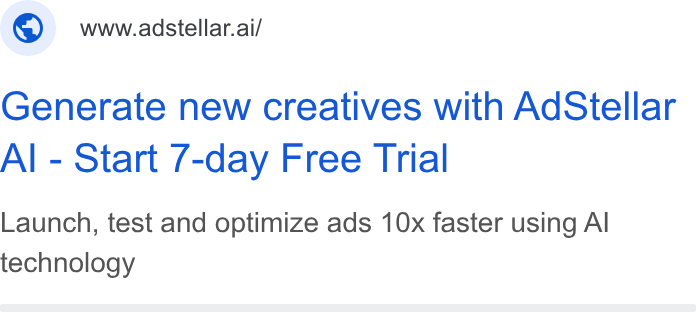
Only one ad is active in the public library as of 2026-07-06, a text ad reading "Generate new creatives with AdStellar AI, Start 7-day Free Trial" bidding on AdStellar's own branded terms rather than generic demand keywords, which reads as protecting the branded search results rather than generating new demand. Notably, for a tool built to run Meta ad campaigns, no AdStellar-run Meta ads appear in the data at all.
07 Paid ads
This founder-led SaaS also runs paid acquisition. Here are the live ads doing the work, each with the X-ray and a play you can adapt.
- Running
- 17 days (longevity = it's converting)
- Hook
- A blue globe icon next to "www.adstellar.ai/" followed by the headline "Generate new creatives with AdStellar AI - Start 7-day Free Trial"
- CTA / offer
- Start 7-day Free Trial
- Audience
- Businesses or marketers looking to improve their ad creative process and performance, indicated by terms like "creatives," "ads," and "AI technology."
Why it works. Puts the product benefit and a 7-day free trial together in the search headline so marketers searching for ad creative tools can try AdStellar risk free before paying.
Prominent display of the core benefit and offer in the main headline: "Generate new creatives with AdStellar AI - Start 7-day Free Trial" Put your core benefit and a time-boxed free trial length in the same headline instead of splitting them across separate lines.
08 The playbook
The channels are not separate. They are one system where each stage feeds the next. Here is the read, then the plays to run tomorrow.
The inferred playbook
Attention starts in organic branded search and advertiser-forum mentions, converts on a single low-friction plan, and compounds through an affiliate program, but the loop has a real gap where product-intent content should be.
Branded search (62.5% of the channel mix) and unprompted mentions in Facebook-ads and dropshipping communities bring in visitors who are already comparing AI ad tools.
A single $50/mo Team plan bundling 25,000 AI credits with unlimited seats and ad accounts, paired with a 7-day free trial requiring no credit card, keeps the buying decision simple.
Dig deeper+3▾
The ~$165 blended ARPU runs well above the $50 sticker plan, implying many paying accounts spend on more than the base tier, though public pricing doesn't itemize which add-ons or usage close that gap.
The organic content that ranks best has little to do with running Meta ads, and the product's own paid-social channel sits unused, leaving both the content engine and the paid channel mismatched to the core buying intent already showing up in branded search.
free-to-paid conversion, churn, CAC.
Let your buyers find you in their own shortlist threads
The proofAdStellar shows up unprompted across four marketing subreddits between January and May 2026, including a 40-comment thread that tested it against rivals with $900k of real ad spend, without any visible brand-run launch post.
The adaptationFind the two or three places your buyer already posts "which tool should I use" questions, a subreddit, a niche Slack, a forum, and search it for your product category plus "vs" or "recommend." Start by answering the most active thread you find with a genuinely useful, specific comparison rather than a pitch. The mechanism: buyers trust a detailed peer answer inside their own community far more than any ad, so being the best answer in an existing thread earns the recommendation an ad could never buy.
Cost: $0 · Time to signal: weeks · Works pre-PMF: yes
Collapse your pricing into one plan with a no-card trial
The proofAdStellar sells a single $50/mo plan bundling credits, seats, and ad accounts together, paired with a 7-day free trial that requires no credit card, sitting behind a 182-subscriber base.
The adaptationIf you're running multiple tiers gated by features, test collapsing them into one plan metered by a single usage number (credits, seats, whatever maps to value), and drop the credit-card requirement at signup. First step: rewrite your pricing page to one plan and one trial button with no CC field, and set the free allotment generous enough that a new user reaches their first real result inside the trial window. Removing both the tier-choice and the card-entry decision points is what cuts signup friction, not the price itself.
Cost: $0 · Time to signal: weeks · Works pre-PMF: conditional, yes if the core product loop already works; simplifying pricing on a confusing product just produces faster trial churn.
Turn your loudest fans into a recruited affiliate force
The proofAdStellar runs a public Rewardful-powered affiliate program at a dedicated page, and referral traffic already sits at 13.4% of its total visits.
The adaptationSet up a simple affiliate tool (Rewardful, FirstPromoter, or similar) with a flat recurring commission, then recruit your first affiliates directly from the community threads found in Play 1: message the people already vouching for you positively and offer them a tracked link. The mechanism is that people who already recommended you for free will convert better as paid affiliates than any cold-recruited partner.
Cost: under $500 · Time to signal: months · Works pre-PMF: no, this needs existing customers or vocal advocates to recruit from first.
Bid on your own brand name once people start searching for it
The proofAdStellar's lone active ad, as of 2026-07-06, bids on its own branded search terms rather than generic category keywords, a defensive move, not a demand-generation one.
The adaptationCheck your own branded search volume in Search Console or a keyword tool once you have any word-of-mouth traction; if people are searching your name, run one lightweight branded-term ad before spending anything on generic keywords. This protects the branded result page from competitors or reviewers outranking you for a few dollars a click, cheaper insurance than broad demand-gen bidding.
Cost: under $500 · Time to signal: days · Works pre-PMF: no, this only makes sense once branded search demand already exists.
Publish easy, adjacent how-to content and bridge it to your product
The proofAdStellar's top organic page, a generic guide to Instagram navigation unrelated to ad automation itself, drives 93% of its tracked organic traffic while ranking only around position #18.
The adaptationIdentify three or four broad, low-competition "how does X work" questions your audience searches regardless of whether they're ready to buy, write short authoritative guides for them, and add one clear call-to-action bridging each page back to your core product. Start by drafting the first guide and publishing it on your existing blog. Broad literacy content ranks faster than product-specific keywords, so it buys top-of-funnel volume while the CTA does the work of converting curiosity into product interest.
Cost: $0, or under $500 for a freelance writer · Time to signal: months · Works pre-PMF: yes Not transferable at an earlier stage: the affiliate-recruitment and branded-search plays both assume you already have customers or vocal advocates and measurable branded search demand. A pre-launch founder should run the community-seeding and content plays first and earn that baseline before the affiliate and branded-defense moves make sense.
You just read how AdStellar does it. Tomorrow it is someone else.
Every morning we take one company that is actually growing and break down where its customers come from: the ads still running after a year, the channel doing the real work, and the play you can run this week.
Systemaic · directional intelligence. Traffic, spend, and reach figures are SimilarWeb-style estimates and qualitative reads of public data, not audited numbers. Built on real public receipts.
// teardowns with a similar GTM motion
sources & receipts (1)
Live ad libraries: google ad library
Traffic, spend, and revenue figures are estimates as noted in the report; the links above are the primary public artifacts.