- 01Launch across every niche channel in the same week
- 02Post your build log where your users already hang out
- 03Rebuild your product as infrastructure for the platform shift already underway
- 04Relaunch only when a real milestone gives you a reason
01 Snapshot
The one-glance read on who they are and how they grow. Each point is verifiable from the receipts above.
Postiz is an open-source AI social media scheduler for creators, agencies, and AI-agent workflows, running at a publicly reported $158,276 MRR across 4,717 paying subscriptions.
founder-led, open-source launch-led growth.
~463,364 monthly visits (+90.6% over the last 3 months), a founder X following of 7,930, and nine active Google text ads as of 2026-07-03.
"People think an app can't make money because it's open-source. Postiz makes money because it's open-source."
As of 2026-07-03, three of Postiz's nine active Google ads were single-day flights (June 10, 12, and 17) sitting next to one 26-day proven winner, pointing to live brand-term creative rotation.
Postiz's biggest revenue jumps came from repositioning the same open-source product for a new buyer, AI agents calling its API, rather than from any new acquisition channel.
02 How it unfolded
The order the channels came online. Sequence is strategy: what they did first, and what they layered on once demand existed.
03 Traffic & channel mix
Estimated demand, the channel split behind it, and the keywords and referrers doing the work. Directional modeling, not audited analytics.
Traffic sources
Top search keywords
| Keyword | Volume | Weight | CPC |
|---|---|---|---|
| postiz | 86k | $1.61 | |
| postiz github | 7.5k | - | |
| postiz api | 990 | - | |
| potiz | 700 | - | |
| postiz open source | 1.6k | - |
Top referring sites
Closest competitors by audience
Postiz draws an estimated 463,364 monthly visits, up 90.6% over the last 3 months. Direct traffic leads the mix at 41.9%, search organic follows closely at 38.6%, and referrals add 9.9%; the remaining slice, social organic, paid search, generative-AI referrals, email, and display, together totals under 10% of visits. The near-even split between direct and organic search suggests a lot of that "direct" traffic is branded recall from the founder's own content, typed straight into the address bar rather than clicked from a search result.
The keyword demand it's chasing is dominated by its own name: "postiz" alone pulls 85,520 monthly searches, "postiz github" adds 7,500, and "postiz api" another 990, a demand curve that's almost entirely branded and developer-intent rather than generic-category search.
Its top referrer is github.com, meaning the open-source repository itself sends more traffic than any marketing page, ahead of appsumo.com (a deal marketplace listing converting discount-motivated shoppers) and openalternative.co (an open-source software directory positioning Postiz as a Buffer alternative). The closest named competitors, planable.io, mixpost.app, and postplanner.com, span closed-source incumbent, open-source peer, and legacy SMB tool, showing Postiz competes across both the traditional scheduler market and the newer open-source-alternative niche.
04 Channel map
Not traffic share. How much weight the growth system actually puts on each channel, with a one-line read on the role it plays.
What drove growth
05 Who they’re hiring
Open roles read like a roadmap: the functions they’re staffing show where the company is investing next and what stage it’s at.
1 open role
06 The motions doing the work
For founder-led SaaS the breakdown shifts from ads to traction: where the first users came from, how the founder grows it in the open, and the compounding organic surface.
Postiz's first real traction came from a founder-run Reddit post, not its official Product Hunt debut three months later.
On 2024-08-30, the founder posted "Postiz - open-source social media scheduling tool" to r/selfhosted under his personal account, pulling a 527 score and 164 comments, the earliest sign real users existed.
He then engineered a single week that hit GitHub trending, Hacker News, Reddit r/selfhosted, Lemmy, and Dev.to/Medium/Hackernoon simultaneously to spike star counts, a tactic he described as treating open source itself as the distribution channel (source).
Dig deeper+2▾
The Product Hunt launch on 2024-11-20, "Your ultimate AI social media scheduling tool," pulled 1,212 upvotes and 106 comments, landing the same day as his best Show HN post (42 points, 4 comments), the two surfaces reinforcing each other.
Between August 2024 and August 2025 he submitted variations of the same Show HN post nine times; eight scored under 20 points and only the one timed to the Product Hunt launch broke through, a relaunch-until-it-sticks pattern showing persistence mattered more than any single post's quality.
Nevo David's personal X account is the primary engine of Postiz's growth story, turning a running MRR ledger into a recurring content series.
From @wickedguro (7,930 followers), David posts near-daily revenue updates: "$41k MRR" (2026-02-28, 170 likes), "$66,062 MRR" (2026-03-20), "Closing on a $1,000,000 ARR" (2026-04-02, 52,220 views), the habit itself becoming the recurring hook.
Under the same identity (sleepysiding22), he posts recurring version-update threads to r/selfhosted, where an "open-source alternative to any SaaS" roundup that put Postiz first scored 1,629 upvotes (350 comments), a direct product-launch post scored 605, and a "$700 monthly" milestone post to r/SaaS scored 410, with a "$14.2k monthly" milestone to r/indiehackers scoring 565. r/selfhosted is where he returns most often and scores highest.
Dig deeper+2▾
LinkedIn (nevo-david, 7,756 followers) carries the same founder identity and build-in-public framing in its bio, but the evidence shows no Postiz-branded account posting at comparable volume to the founder's own feed.
After an X exchange he later called defensive ("I was wrong... I got super defensive"), he opened a 2025-07-02 r/selfhosted post with a direct apology before the product update, the personal-brand channel doubling as damage control.
Search organic traffic (38.6% of the channel mix) rivals direct traffic, but the pages driving it are less a landing-page funnel than a set of compounding open-source distribution surfaces.
GitHub, the top referral source covered in Traffic & Channel Mix, means the open-source repository itself does the heaviest link-and-discovery lifting, not a blog funnel.
David describes a "SEO Skill" that loads a YouTube video, transcribes it with Deepgram, clips the useful sections, and turns the transcript into an article, a repeatable video-to-article pipeline he credits with a jump in SEO traffic.
Dig deeper+2▾
Rather than take profit early, he says he plowed revenue into "more backlinks, more design materials, more directory listings" and paid community placements, treating link and directory equity as a compounding asset.
Nine Google text ads are active as of 2026-07-03 (longest-running about 26 days), and the creative is almost entirely the bare domain and brand name ("Postiz Official Website," "Postiz Social Scheduler"), consistent with defending branded search rather than generating new demand.
07 Paid ads
This founder-led SaaS also runs paid acquisition. Here are the live ads doing the work, each with the X-ray and a play you can adapt.
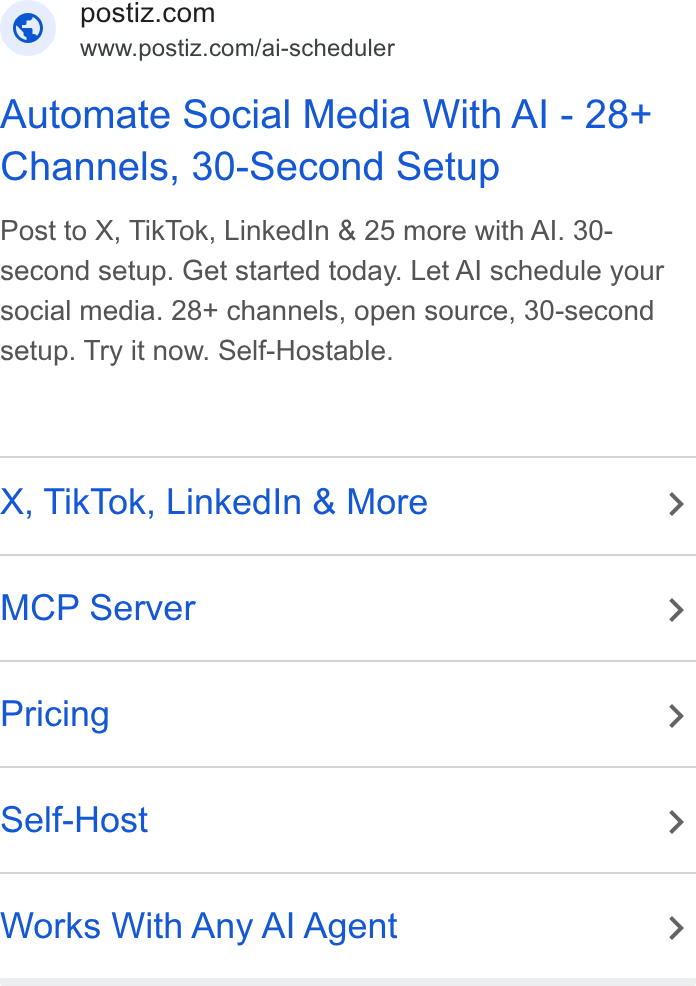
- Running
- 26 days (longevity = it's converting)
- Hook
- postiz.com www.postiz.com/ai-scheduler Automate Social Media With Al - 28+ Channels, 30-Second Setup
- CTA / offer
- Try it now.
- Audience
- Individuals or businesses managing social media, indicated by 'Automate Social Media With AI' and mentions of 'X, TikTok, LinkedIn'.
Why it works. Targets high-intent searchers by quantifying both platform coverage and setup speed, turning two abstract benefits into hard numbers.
Headline with specific numbers and a bold claim: "Automate Social Media With Al - 28+ Channels, 30-Second Setup" Put two concrete numbers in your headline, one for scale and one for speed, instead of vague adjectives like fast or easy.
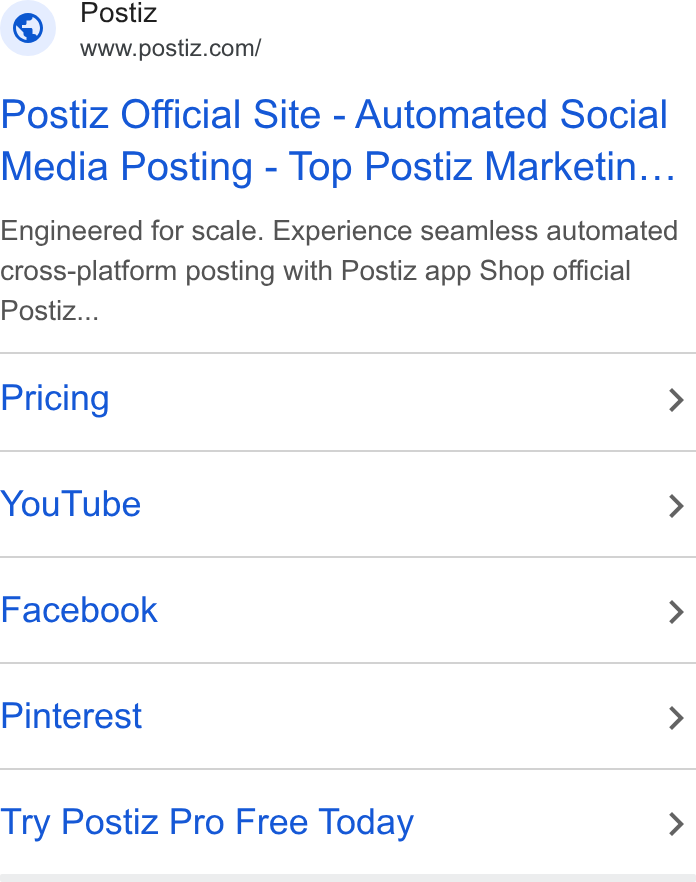
- Running
- 1 day (new — still being tested)
- Hook
- Postiz Official Site - Automated Social Media Posting - Top Postiz Marketin... Engineered for scale. Experience seamless automated cross-platform posting with Postiz app Shop official Postiz...
- CTA / offer
- Try Postiz Pro Free Today
- Audience
- Businesses or individuals seeking automated social media management, indicated by the text "Automated Social Media Posting" and references to platforms like YouTube, Facebook, and Pinterest.
Why it works. Search ad copy leads with a scale claim aimed at agencies and teams managing many accounts, then backs it with the specific feature that delivers it.
Headline and description: "Postiz Official Site - Automated Social Media Posting - Top Postiz Marketin... Engineered for scale. Experience seamless automated cross-platform posting with Postiz app Shop official Postiz..." Lead your search ad description with one scale-oriented claim, then immediately name the specific feature that makes it true.
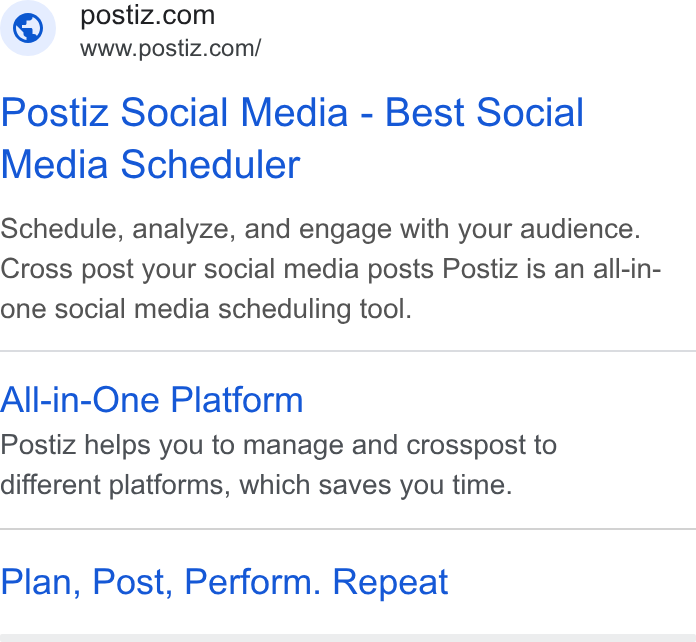
- Running
- 16 days (longevity = it's converting)
- Hook
- postiz.com www.postiz.com/ Postiz Social Media - Best Social Media Scheduler
- Audience
- Businesses or individuals managing social media, indicated by the focus on 'Social Media Scheduler', 'audience engagement', and 'cross-posting'.
Why it works. Wins on branded plus category search terms, appearing right when a buyer already comparing schedulers is deciding between options.
Headline with a bold claim: 'Postiz Social Media - Best Social Media Scheduler' Write your Google search headline using the literal category keyword customers search for, not a clever tagline.
08 In their own words
Pulled from interviews and community sessions. The quotes are the angle; the takeaway is what to do with it.
$21K → $100K MRR in Weeks by Selling to AI Agents 🦞 ↗Multiples AI (Tom Granot & Andy Katz) · 50k views · 22 min▶ View source“I started to do everything possible to be open claw ready. The first thing I did is that I created a CLI... it uses a lot less context in order to do stuff when you use the CLI instead of writing like a whole API command.”
Expand
Nevo grew Postiz from $21K to $109K MRR primarily by riding the OpenClaude/agentic wave: he spotted a viral article (7M views) about using Postiz with OpenClaude, then systematically made Postiz 'agent-ready' (CLI, Claude Hub listing, awesome-lists placement) and aggressively published X articles on trending AI topics to capture the algorithm's interest-based distribution. The foundation was 1.5 years of open-source growth hacking that built 30K GitHub stars and an audience of technical founders before the agentic moment arrived.
“I go to a lot of awesome libraries on GitHub and I put Postiz there for AO. So like if somebody search on the LLMs, they can also find Postiz.”
“I started to scale articles, and every time I saw something trending, I tried to scale more and more and more articles because I understood this is like the biggest growth hack I can do.”
“X became very much of an interest platform and not a follower-based platform. It means that if there is something super interesting that everybody's talking about right now, and you write about it on X... it will just match the content with the algorithm.”
“This is an underserved audience that nobody is giving them right now a solution. Everybody that's now building something for agents is basically just serving a lot of audiences that are just not being served at the moment.”
When a viral use-case surfaces (even from a 200-follower account), treat it as a signal: immediately audit what 'agent-ready' means for your product and ship the gaps (CLI, MCP, Hub listings) before competitors notice.
List your tool everywhere agents look: Claude Hub, OpenAI plugin stores, GitHub awesome-lists — LLMs crawl these to recommend tools, so placement there drives zero-cost discovery.
Publish X articles on whatever is trending in your space the moment it peaks; X's interest-based algorithm will distribute them far beyond your follower count if the topic has momentum.
Use open source as a distribution channel before you have revenue: 30K GitHub stars gave Postiz a pre-built audience of technical founders that converted when the agentic wave hit.
Target the underserved technical edge of a trend early — the 'small X audience tech' cohort is tiny but has no incumbent solution and generates the loudest word-of-mouth on the platforms where the trend lives.
“Open source is a great way to introduce your project to a million of developers.”
Expand
Nevo David grew Postiz to $17K/month by treating open source as a distribution channel rather than a product philosophy. His core move was engineering a coordinated launch across GitHub trending, HackerNews, Reddit r/selfhosted, Lemmy, and Dev.to/Medium/Hackernoon in the same week to spike star counts and reach trending status. He relies on developer word-of-mouth, user-generated content, and SEO from third-party blog posts as ongoing organic growth loops.
“Developers are not buying persona and they will probably not pay you. So don't try to find some elaborate way to make them to pay you. You just need to make like a very good docs and make sure they know how to use your SaaS. You can look at this as kind of like a free tier to your SaaS.”
“Word of mouth is like a really great channel. Tons of user generated content on social media. So every time I go and I search for Postiz on social media every day I see some post about some developer trying to sell Postiz.”
“Don't be afraid for somebody copying your product because today the only thing that is winning usually is brand. Anybody that will compete with you will always be one step behind you and probably just abandon it at some point.”
“Make sure all these five steps are going on at the same week. That's very important. So you get into the main trending feed. Once you are there, you will see your star count rocketing very fast.”
Coordinate a single-week launch blast across HackerNews (Show HN → GitHub repo), Reddit r/selfhosted, Lemmy, Dev.to/Medium/Hackernoon, and your own X/LinkedIn/newsletter simultaneously to spike GitHub stars and hit the trending feed.
Treat your GitHub README as your primary marketing landing page: position as 'open-source alternative to [known tool]', add a clear license, and pre-create contributor issues so developers know exactly what to build.
Post to r/selfhosted every time you ship a new version — self-promotion is accepted there for open source projects, giving you a repeatable free distribution hit each release cycle.
Write articles on Dev.to, Medium, and Hackernoon optimized for Google Discover (invest in title and cover image) — Nevo cites these as his main traffic source, driven by the Discover feed surfacing them to interested readers.
Do not monetize developers directly; instead use their self-hosting as a free-tier flywheel that generates word-of-mouth, UGC, SEO backlinks, and enterprise leads who need self-hosted support contracts.
How He Makes $118K a Month Selling to AI Agents ↗Rob Hallam · 4.2k views · 65 min3rd-party breakdown▶ View source“I was planning to finish the year between 30 to 40K MRR maximum. Never imagined that maybe I should plan for 200K by the end of the year.”
Expand
Postiz grew from $20K to $118K MRR in roughly three months by repositioning from a human-operated social media scheduler to an agent-native tool, with the core insight being that agents doing the scheduling work eliminates the churn problem endemic to the category. The founder's existing open-source product, public API, and ability to move fast as a solo operator let him be first to ship agent integrations when OpenClaude went viral, compounding into durable positioning that outlasted the initial hype cycle.
“When people automate the entire workflow with n8n, Make or Zapier, they're going to have like so many posts for around the week that is going to reduce churn a lot, and it did.”
“The agent do so much work, you already reduce so much of your churn, basically.”
“I was one of the first to have a skill, to be in this whole ecosystem, listing myself everywhere. And this is what we said before about the power of already having a product and just waiting for the right moment.”
“You can shift it to agent in a minute. You just need to create one MD file. If you have a public API, it takes you a minute.”
Reposition the homepage entirely around agent use before anything else — swap human-first copy for agent-first framing ('run on autopilot with AI agents') and kill the manual-scheduling narrative to attract the technical early-adopter segment that actually pays for agent tooling.
Turn your existing public API into a skill.md file (plain markdown describing all commands), publish it as a GitHub repo, and submit to NPX agent skills — this makes you agent-ready in under an hour with zero new backend code.
Build a CLI wrapper over your API rather than exposing raw HTTP; it shrinks LLM context usage, keeps API keys out of context windows, and makes agent interactions faster — the founder had Claude generate the entire CLI from his existing API docs in one pass.
Build an MCP server for the ChatGPT/Claude.ai audience who cannot install local skills; embed the API key directly in the MCP URL to eliminate authentication friction for non-technical users.
Treat every new agent tool that goes viral on X as a launch opportunity and ship a native integration the same week — Buffer took years to release an API while Postiz had one before agents even existed, and that speed asymmetry became the core competitive moat.
09 The playbook
The channels are not separate. They are one system where each stage feeds the next. Here is the read, then the plays to run tomorrow.
The inferred playbook
Postiz's loop starts with the founder's own audience and the open-source repo, not with a self-serve landing page absorbing cold traffic.
the founder's personal channels and the open-source repo's GitHub and directory referrals feed the top of funnel, while paid stays defensive-only.
the biggest recent growth lever wasn't a new channel but a product repositioning, turning Postiz into the posting layer AI agents call via API, which the founder says took MRR from roughly $21K to over $100K within a few months, without new paid spend (source).
Dig deeper+3▾
four tiers from $29/month (Standard) to $99/month (Ultimate) sit against a $34 blended ARPU, meaning the median paying account clusters near the entry tier rather than upgrading into the AI-heavy Pro/Ultimate plans.
the founder has flagged it repeatedly in his own updates ("churn started to hit, growth is not slowing," 2026-03-22), hiring a dev-rel and building a support agent to address it, the one part of the loop he describes as unsolved.
free-to-paid conversion, churn, CAC.
Launch across every niche channel in the same week
The proofPostiz's coordinated GitHub/HN/Reddit/Lemmy launch week (see Launch & Traction) is the proof point, one deliberately simultaneous push instead of a slow trickle.
The adaptationPick the four or five places your own users already gather, a subreddit, a dev directory, a niche Discord, a relevant newsletter, and hold your launch drafts until you can fire them all in the same 48-hour window instead of trickling them out over weeks. Simultaneous timing matters because each surface's algorithm and audience treats a concurrent spike as more newsworthy than a slow drip, and cross-links between the posts compound each other's ranking.
Cost: $0 · Time to signal: days · Works pre-PMF: yes
Post your build log where your users already hang out
The proofthe founder's Reddit-first playbook (see Build in Public) is Postiz's highest-scoring channel, peaking at 1,629 upvotes on one post.
The adaptationidentify the single subreddit, forum, or community where your ICP already asks for recommendations, and post a genuine version-update or lessons-learned thread there on a real cadence, answering every comment yourself. Start by drafting one honest "here's what I shipped and why" post for the community that has argued about your category before; a founder answering in the comments carries credibility a promo post can't buy.
Cost: $0 · Time to signal: days · Works pre-PMF: yes
Rebuild your product as infrastructure for the platform shift already underway
The proofexpanded above in The Inferred Playbook, repositioning Postiz for AI-agent buyers is the growth engine behind its steepest MRR jump.
The adaptationwatch for the ecosystem your own category is being absorbed into, an AI agent layer, a marketplace, a browser extension platform, and ship the integration surface (a public API, a CLI, a listing in that ecosystem's directory) before your competitors do. Start by shipping one narrow, well-documented API endpoint that lets a popular automation tool in your space call your product directly, then get listed in that tool's own integrations directory.
Cost: dedicated budget or hire · Time to signal: weeks to months · Works pre-PMF: conditional, only pays off once you already have a working product and an API surface to extend
Relaunch only when a real milestone gives you a reason
The proofnine Show HN resubmissions over a year (see Launch & Traction) mostly flopped; only the one timed to the Product Hunt launch broke 40 points.
The adaptationone flop on a single-shot launch board is not a verdict, but note what the proof actually shows: eight of nine resubmissions did nothing, so volume alone is not the play. Resubmit only when a genuine product milestone gives the community something new to look at, and time it to coincide with a second, independent launch moment so the two surfaces reinforce each other. Most launch boards, Hacker News especially, enforce anti-repost norms: a resubmission without something new reads as spam and can get you flagged.
Cost: $0 · Time to signal: days · Works pre-PMF: yes
Turn your own explainer videos into search-indexed articles
The proofPostiz's video-to-article SEO pipeline (see Content & SEO Engine) is the template, transcribe, clip, rewrite.
The adaptationtake any video content you already have, a demo, a conference talk, a customer call, run it through a transcription tool, and rewrite the transcript into a structured article targeting the long-tail question the video answers. Start with your single best-performing video and ship one article this way before building the pipeline further. The mechanism is that transcript-derived articles inherit the video's real audience intent instead of guessing at keywords cold.
Cost: under $500 · Time to signal: weeks · Works pre-PMF: yes Not transferable at an earlier stage: the agent-economy repositioning play (Play 3) leans on an already-built API and roughly 1.5 years of open-source distribution behind it. A reader with no product or existing audience should run Plays 1, 2, and 4 first, and treat Play 3 as the payoff once there's something worth repositioning.
You just read how Postiz does it. Tomorrow it is someone else.
Every morning we take one company that is actually growing and break down where its customers come from: the ads still running after a year, the channel doing the real work, and the play you can run this week.
Systemaic · directional intelligence. Traffic, spend, and reach figures are SimilarWeb-style estimates and qualitative reads of public data, not audited numbers. Built on real public receipts.
// teardowns with a similar GTM motion
sources & receipts (10)
Live ad libraries: google ad library
Launch archives: Hacker News: Show HN: Postiz – open-source social media scheduling tool · Hacker News: Show HN: Postiz – open-source social media scheduling tool · Hacker News: Ask HN: What would you like to see in Postiz? · Hacker News: Setup Postiz on Coolify · Hacker News: Show HN: Automate social media with postiz and n8n
Founder interviews: a free social media scheduler, self hosted postiz · $21K → $100K MRR in Weeks by Selling to AI Agents 🦞 · How I Built It: $17K/Month Open Source SaaS · How He Makes $118K a Month Selling to AI Agents
Traffic, spend, and revenue figures are estimates as noted in the report; the links above are the primary public artifacts.