- 01Cap a presale before you launch
- 02Ship a narrow free tool instead of a blog post
- 03Publish tutorials natively on the platform your customers live on
- 04Post milestones, not updates
01 Snapshot
The one-glance read on who they are and how they grow. Each point is verifiable from the receipts above.
An AI scriptwriting and ideation platform built specifically for YouTube creators. Its founder reported on Indie Hackers in August 2025 that revenue was "over $62K a month," on track for a $1M/yr run-rate, bootstrapped from $0 and run solo for the first 1.5 years before a co-founder joined.
Founder-led, launch-led, with a real paid-search layer underneath.
~149,700 monthly site visits (+16.7% over the last 3 months), founder Gil Hildebrand's X account at 5,961 followers, and 53 total Google ads (5 active as of 2026-07-11).
The newest Google ad variants lean on a numeric social-proof hook ("Trusted by 4,593 Creators") run through newer, smaller advertiser accounts.
Subscribr sells a YouTube tool and markets almost entirely ON YouTube, its own 30-plus-video tutorial channel is simultaneously the demo, the SEO surface, and the trust-builder, a distribution loop few SaaS companies outside the creator-tools category can replicate.
02 How it unfolded
The order the channels came online. Sequence is strategy: what they did first, and what they layered on once demand existed.
03 Traffic & channel mix
Estimated demand, the channel split behind it, and the keywords and referrers doing the work. Directional modeling, not audited analytics.
Traffic sources
Top search keywords
| Keyword | Volume | Weight | CPC |
|---|---|---|---|
| subscribr | 4.1k | $0.65 | |
| subscribr ai | 1.3k | $1.88 | |
| sub scribe | 1.3k | $0.59 | |
| youtube thumb download | 0 | - | |
| youtube script | 22k | $0.61 |
Top referring sites
Closest competitors by audience
Subscribr pulls roughly 149,700 estimated monthly visits, up 16.7% over the last 3 months. Direct traffic dominates at 62.1%, typical of a product whose users return via bookmark or habit rather than fresh discovery; Social Organic follows at 13.3% and Search Organic at 11.4%, together showing the YouTube-channel-plus-SEO combination doing real work. Referrals sit at 5.9%, and the rest, paid search, Gen AI referrals, email, and paid social, together total under 8% and aren't material to the story. The clearest demand signal is the category term "youtube script" at 21,890 monthly searches, a market Subscribr is both ranking and bidding into; branded search for "subscribr" (4,090/mo) and "subscribr ai" (1,320/mo) shows real recall built off the launch and the founder's audience. Referring traffic comes from symbaloo.com, a bookmarklet/dashboard tool suggesting inclusion in curated creator-resource lists, and boringcashcow.com, a smaller niche site sending targeted referral traffic. The closest competitive set includes vidiq.com and tubebuddy.com, both direct YouTube-creator tools Subscribr is fighting for the same search real estate, plus jasper.ai, a broader AI-writing tool in the adjacent category.
04 Organic content
The specific pages earning their organic search traffic, and the pattern behind why they rank. Adapt the format, not the topic.
Subscribr's organic traffic is concentrated in two pages: the homepage (67.3% of organic visits) and a free youtube-keyword-research tool page (25.2%), with three long-tail utility and guide pages splitting the remainder. The pattern is a free-tool wedge: narrow, single-purpose utilities (a keyword research tool, a thumbnail grabber, a tag generator) built as their own indexable pages rather than buried as in-app features. These rank because they answer a tool-shaped search query directly and let a visitor get value before ever signing up, and one of them (targeting "ai keyword vidiq") ranks on a query containing a competitor's brand name, a direct conquesting play. It's a compact, replicable content system: fewer, sharper utility pages instead of a sprawling blog.
Top pages by organic traffic
05 Channel map
Not traffic share. How much weight the growth system actually puts on each channel, with a one-line read on the role it plays.
What drove growth
06 The motions doing the work
For founder-led SaaS the breakdown shifts from ads to traction: where the first users came from, how the founder grows it in the open, and the compounding organic surface.
Subscribr's first users came from a capped presale that Gil ran off his own X account, not a marketplace launch.
In February 2024, Gil announced a waitlist-gated presale, "800+ on the waitlist, 50 spots available," at a 70% lifetime discount, then posted an update the same week that half the spots were already gone, explicitly framing the discount as a loss-leader to recruit early "partners" in building the product.
The public launch went live on 2024-04-16 to 30,769 views and 156 likes; a follow-up post the next day used a 12-hour countdown and an engagement-bait mechanic (like, comment "44", follow) to push a 44% lifetime discount before it closed.
Dig deeper+2▾
By 2024-04-21, a day after launch, Gil reported crossing 100 customers and $30k in combined presale-plus-launch revenue, the fastest-moving proof point in the whole timeline.
Gil ran Subscribr alone for 1.5 years before bringing on Bryan Ng as co-founder in September 2025; Ng brought a scriptwriting-agency background (1,000+ scripts written for large YouTube channels) and his own creator-education audience into the company.
The single-line read: Subscribr's build-in-public motion runs almost entirely through Gil Hildebrand's personal X account, not the brand handle.
Gil ties nearly every post to a concrete number tied to a real moment, waitlist size at presale, revenue and customer count the day after launch, rather than vague progress updates, which is what gives the account its credibility.
A December 2025 post recapping a Starter Story feature (a site that profiles bootstrapped founders) restated the founding numbers, "$0 funding, $20K pre-launch, on track for $1M revenue in year two," a historical framing of the company's early trajectory rather than a current figure.
Dig deeper+2▾
The September 2025 co-founder announcement spent most of its length establishing Bryan Ng's independent credibility (agency scripts written, his own education channel) rather than presenting him as a hire, positioning the addition as a merger of two audiences.
There's no evidence of the founder posting on Reddit; the build-in-public engine is single-platform by design, concentrated where the founder already had an audience.
The lead sentence: Subscribr's real SEO asset is the product category itself, YouTube, used as a content channel, with the owned-site free tools and an affiliate program layered underneath.
The keyword-research, thumbnail-grabber, and tag-generator pages covered above aren't blog content, they're working utilities that double as top-of-funnel lead capture for the paid product.
A partner program at subscribr.ai/affiliates recruits outside affiliates to drive referral signups, a distribution channel layered on top of the organic and paid motion rather than a replacement for it.
Dig deeper+1▾
Of 53 total Google ads (5 currently active), the proven-winner set leans on friction-removal copy ("Get Started Free, No CC Needed"), targeting generic category terms rather than defending the brand name, real demand generation, not just brand-term defense; a newer bold-claim hook, "Create Scripts In 12 Minutes, #1 AI Scriptwriting Tool," is still in the testing-now bucket. Notably, several of these "free" hooks predate or run alongside a funnel that now leads with a $7 paid trial (confirmed in pricing evidence and repeated across 2026 YouTube video CTAs), suggesting the offer has shifted from a free entry point toward a small paid-commitment filter without every ad creative catching up.
07 Paid ads
This founder-led SaaS also runs paid acquisition. Here are the live ads doing the work, each with the X-ray and a play you can adapt.
- Running
- 545 days (longevity = it's converting)
- Hook
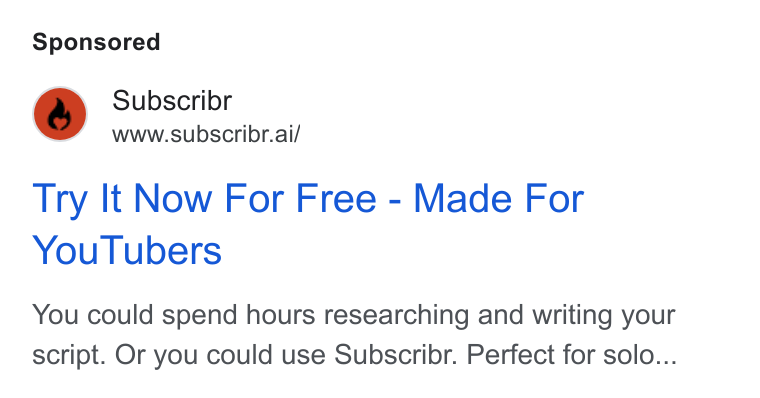
- Sponsored Subscribr www.subscribr.ai/ Try It Now For Free - Made For YouTubers
- CTA / offer
- Try It Now For Free
- Audience
- YouTubers
Why it works. Filters for a single audience by naming them explicitly, so ad spend concentrates on YouTubers rather than general creators.
Direct audience address and free offer in the headline: "Try It Now For Free - Made For YouTubers" Name your exact target audience by title in the headline right after your offer, so unqualified clicks self-select out.
- Running
- 255 days (longevity = it's converting)
- Hook
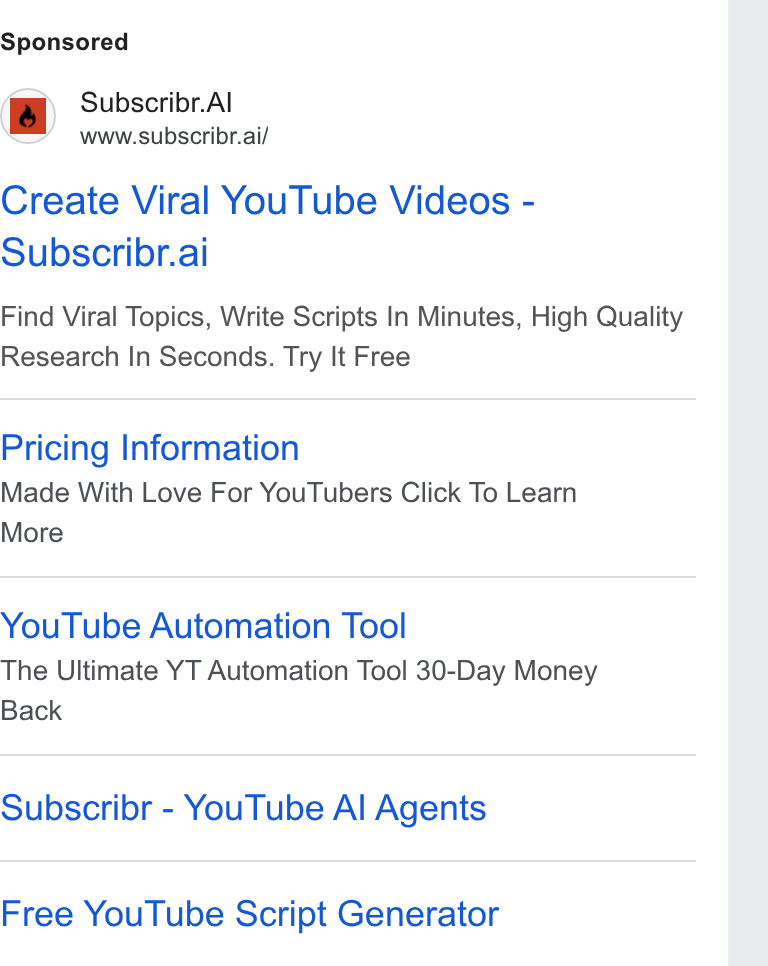
- Sponsored Subscribr.Al www.subscribr.ai/ Create Viral YouTube Videos - Subscribr.ai
- CTA / offer
- Try It Free
- Audience
- YouTubers, indicated by phrases like "Create Viral YouTube Videos", "Made With Love For YouTubers", and "YouTube Automation Tool".
Why it works. Speaks to the bigger goal (channel growth) instead of the tool's literal function, broadening who self-identifies as the buyer.
Headline with a bold promise: "Create Viral YouTube Videos - Subscribr.ai" Write one headline variant around your product's end outcome for the user, not its literal feature, and test it against your feature-led version.
- Running
- 246 days (longevity = it's converting)
- Hook
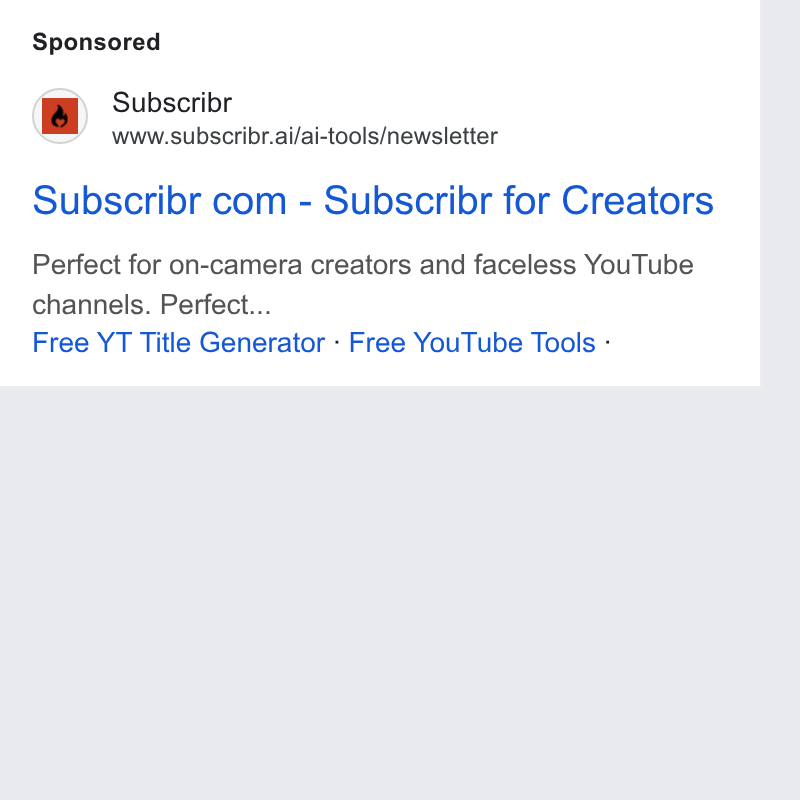
- Sponsored Subscribr www.subscribr.ai/ai-tools/newsletter Subscribr com - Subscribr for Creators
- CTA / offer
- Free YT Title Generator, Free YouTube Tools
- Audience
- The text 'on-camera creators and faceless YouTube channels' directly addresses content creators, specifically those on YouTube.
Why it works. Routes YouTube creators to a newsletter-style free-tools page rather than the core product, testing a lower-commitment entry point.
Headline directly names the target audience and product: 'Subscribr com - Subscribr for Creators' Offer a free, no-signup micro-tool as a side door into your product for visitors not ready to try the main offering.
Show 3 more ads
- Running
- 245 days (longevity = it's converting)
- Hook
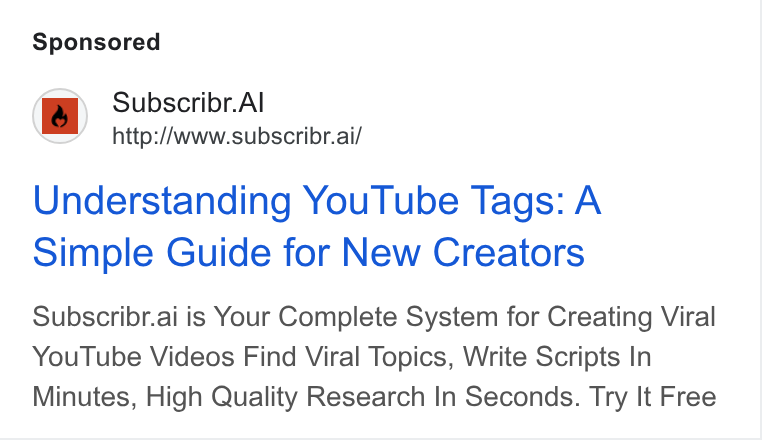
- Sponsored Subscribr.Al http://www.subscribr.ai/ Understanding YouTube Tags: A Simple Guide for New Creators
- CTA / offer
- Try It Free
- Audience
- New YouTube creators, indicated by 'New Creators' in the headline and the focus on 'Creating Viral YouTube Videos' and 'Find Viral Topics'.
Why it works. Captures top-of-funnel creators researching a specific YouTube mechanic, then converts that search intent into a product trial.
Headline addresses a specific pain point: 'Understanding YouTube Tags: A Simple Guide for New Creators'. Write an ad headline as a how-to guide for a narrow tactical question your buyers search, then link it to your product's free trial.
- Running
- 239 days (longevity = it's converting)
- Hook
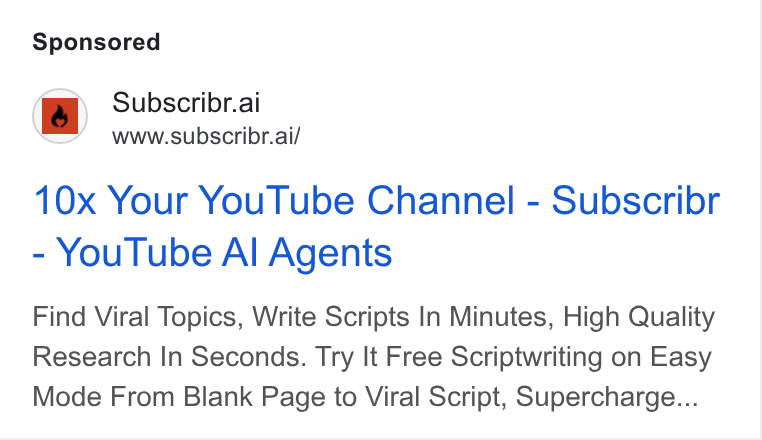
- Sponsored Subscribr.ai www.subscribr.ai/ 10x Your YouTube Channel - Subscribr - YouTube AI Agents
- CTA / offer
- Try It Free Scriptwriting on Easy Mode From Blank Page to Viral Script
- Audience
- YouTube creators and aspiring creators, indicated by 'Your YouTube Channel' and 'YouTube AI Agents'.
Why it works. Targets creators fixated on channel growth metrics with a concrete multiplier, while repositioning the product as autonomous agents rather than a writing aid.
Lead with a quantifiable, aspirational claim: '10x Your YouTube Channel'. State your outcome as a specific multiplier (2x, 10x) rather than a percentage or vague 'grow faster' claim.
- Running
- 225 days (longevity = it's converting)
- Hook
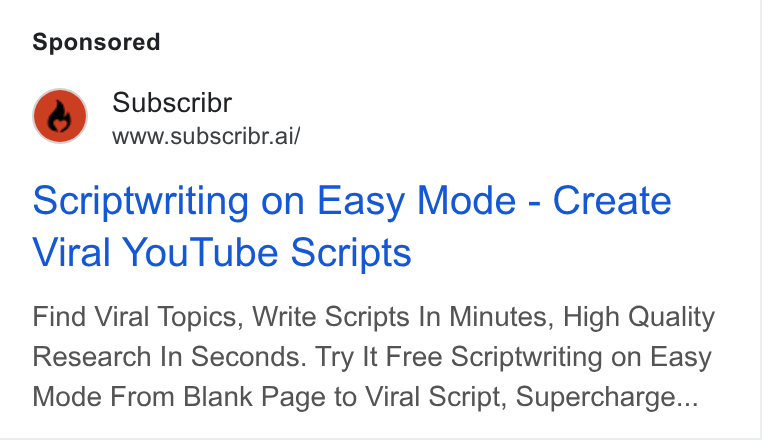
- Sponsored text at the top, followed by a red circular logo with a black flame icon, then the text "Subscribr" and "www.subscribr.ai/". Below that, the blue text "Scriptwriting on Easy Mode - Create Viral YouTube Scripts".
- CTA / offer
- Try It Free
- Audience
- YouTube content creators or aspiring creators, indicated by "Viral YouTube Scripts" and the focus on "scriptwriting" and "research".
Why it works. Targets creators who find scriptwriting effortful by reframing the task itself as an optional difficulty, not a skill gap.
Headline promises ease and virality: "Scriptwriting on Easy Mode - Create Viral YouTube Scripts" Borrow a familiar slang term from your audience's other hobbies (gaming, fitness) to reframe your product's function as a difficulty toggle.
08 The playbook
The channels are not separate. They are one system where each stage feeds the next. Here is the read, then the plays to run tomorrow.
The inferred playbook
The lead read: Subscribr's loop starts on YouTube, converts through a low-friction paid trial, and compounds through the founder's own account, with almost no dependency on a launch-platform moment.
The subscribrai YouTube channel is both the top-of-funnel and the proof of product, a visitor watching a tutorial is already watching the tool work.
The $7, 7-day trial (confirmed pricing evidence, echoed across dozens of 2026 video CTAs) pre-qualifies leads before they hit the undisclosed annual price, a small paid step rather than a true free tier.
Dig deeper+3▾
The founder's X audience (milestone posts, the co-founder merger) and the handful of free-tool pages driving a quarter of organic traffic both compound independent of any single campaign.
There's no visible community layer (no active subreddit, no Discord signal in the evidence), meaning retention and word-of-mouth run entirely through the product itself and the founder's personal reach, a single point of failure if that account goes quiet.
free-to-paid conversion off the $7 trial, churn, CAC, and the exact annual subscription price.
Cap a presale before you launch
The proofGil's February 2024 presale gated 50 spots behind an 800-plus waitlist at a 70% discount, then posted a "half the spots are gone" update days later to compound urgency.
The adaptationBefore you have a finished product, post a short description of what you're building to your own following (even a few hundred people), cap access at a low, specific number, and price it as a steep, one-time discount for people willing to build alongside you. Post one update mid-way through showing spots filling, real or not, the visible scarcity is what drives the second wave.
Cost: $0 · Time to signal: days · Works pre-PMF: yes, this is specifically a pre-launch validation tactic.
Ship a narrow free tool instead of a blog post
The proofA single free keyword-research tool page drives roughly a quarter of Subscribr's organic traffic, more than any article on the site.
The adaptationPick the one calculation or lookup your prospective customers do manually, build it as a standalone page with its own URL and its own tool-shaped keyword target, and give the output away with no login. First step: find the query with "tool," "generator," or "calculator" in it that your audience already searches, and build only that.
Cost: under $500 · Time to signal: months · Works pre-PMF: yes, conditional on already knowing the specific manual task your audience wants automated.
Publish tutorials natively on the platform your customers live on
The proofSubscribr's own YouTube channel, with the founder on camera, mixes product walkthroughs with creator-education content and regularly clears 10,000+ views, doubling as demo and SEO surface.
The adaptationIf your customers already spend time on a specific platform (YouTube, a forum, a marketplace), publish how-to content there under your own face, not just paid placements, teaching the skill your product accelerates rather than pitching the product directly. First step: script one tutorial that solves a real problem your customer is dealing with, mention the product only where it naturally fits.
Cost: $0 · Time to signal: weeks to months · Works pre-PMF: yes.
Post milestones, not updates
The proofGil's highest-engagement posts are all tied to a specific number at a specific moment, waitlist count, day-after-launch revenue, a named co-founder's credentials, never a generic progress update.
The adaptationOn your own account, hold posts until you have a real number attached to a real event (a launch, a revenue threshold, a partnership), then post that number with the context behind it. First step: identify the next milestone on your own roadmap and write the post for it now, before it happens, so you publish the moment it lands.
Cost: $0 · Time to signal: days · Works pre-PMF: yes.
Reactivate an owned audience with a lifetime-deal relaunch
The proofAn Instagram promo counted down a price increase tied to a listing on AppSumo (a lifetime-deal marketplace for software), a pattern of returning to the same deal channel to re-engage past buyers around a product update.
The adaptationOnce you have a base of past customers or trial users, package a real product upgrade as a time-boxed offer through a deal marketplace or your own list, use the countdown itself as the growth mechanic. First step: pick your next meaningful feature release and build a 48-72 hour offer around it for people who already know you.
Cost: dedicated budget or hire, the margin given up on lifetime pricing is a real cost, not a marketing expense · Time to signal: weeks · Works pre-PMF: no, this depends on an existing customer base and a product mature enough to package as a paid upgrade. Not transferable at an earlier stage: the AppSumo-style relaunch and the 53-ad Google Search program both depend on an already-proven funnel and an existing customer base to reactivate; a pre-PMF founder should run plays 1, 3, and 4 first and only layer in paid search or marketplace relaunches once the $7-trial-to-paid math is confirmed.
You just read how Subscribr does it. Tomorrow it is someone else.
Every morning we take one company that is actually growing and break down where its customers come from: the ads still running after a year, the channel doing the real work, and the play you can run this week.
Systemaic · directional intelligence. Traffic, spend, and reach figures are SimilarWeb-style estimates and qualitative reads of public data, not audited numbers. Built on real public receipts.
// teardowns with a similar GTM motion
sources & receipts (1)
Live ad libraries: google ad library
Traffic, spend, and revenue figures are estimates as noted in the report; the links above are the primary public artifacts.