- 01Position as the science-backed dupe of a category leader
- 02Host your own founder-led education content
- 03Recruit a creator affiliate layer before you can afford paid
- 04Turn one winning hook into a creative family
01 Snapshot
The one-glance read on who they are and how they grow. Each point is verifiable from the receipts above.
Science-backed serums and moisturizers ($25-$50, flagship Glow Maker Vitamin C Serum at $32.95/30mL) positioned as the affordable, ingredient-matched alternative to prestige brands, at an estimated $214,242/mo in revenue.
Organic-led, still anchored in community and search traction from its origin story, with paid now layered on top rather than driving the mix.
~154,604 monthly visits (+35.4% over the last 3 months), 99,084 Instagram followers, and 86 active paid ads across Meta (56), Google (18), and TikTok (12) as of 2026-07-03.
Objection-handling creative on serum sensitivity and review-card social-proof overlays lead Meta's newest tests, as of 2026-07-03.
The entire funnel still runs on one 2019-era wedge, a documented ingredient-for-ingredient match to SkinCeuticals' C E Ferulic at a fraction of the price, which seeded Reddit trust first and only later became ad copy.
02 How it unfolded
The order the channels came online. Sequence is strategy: what they did first, and what they layered on once demand existed.
03 Traffic & channel mix
Estimated demand, the channel split behind it, and the keywords and referrers doing the work. Directional modeling, not audited analytics.
Traffic sources
Top search keywords
| Keyword | Volume | Weight | CPC |
|---|---|---|---|
| maelove | 5.3k | $0.85 | |
| maelove glow maker | 2.3k | $1.06 | |
| vitamin c serum | 55k | $0.72 | |
| maelove shampoo | 1.1k | - | |
| maelove skincare | 450 | $0.69 |
Closest competitors by audience
Maelove pulls an estimated ~154,604 monthly visits, up 35.4% over the last 3 months. Search Organic leads the mix at 37.6%, consistent with five branded pages holding #1 rankings for their own product names. Affiliate is the second-largest channel at 19.7%, a notably high share for a DTC skincare brand and a sign that creator and shop-link referrals are doing real conversion work, not just awareness. Direct traffic follows at 19.5%, reflecting repeat buyers typing the URL directly. Paid search (7.8%) and paid social (4.7%) form a modest paid layer, a striking contrast to the 86 active ads running across three platforms: the rest, display, organic social, referrals, email, and AI-assistant traffic, totals under 11%.
Their keyword footprint splits into two demand pools. "Vitamin c serum" (55,180 searches/mo) is the broad category term they compete into against SkinCeuticals and Paula's Choice, while branded terms like "maelove" (5,340/mo) reflect word-of-mouth built well before paid existed. A third term, "maelove shampoo" (1,070/mo), signals a newer hair-care push that shows up again in their Google ad creative.
Of the competitor set, skinceuticals.com is the clearest read: its presence confirms Maelove is still measured against the exact prestige product it was built to dupe. Paulaschoice.com and neostrata.com round out the field as other science-forward, ingredient-led competitors fighting for the same value-conscious, ingredient-literate buyer.
04 Organic content
The specific pages earning their organic search traffic, and the pattern behind why they rank. Adapt the format, not the topic.
Their organic traffic concentrates on the homepage and two flagship product pages (Glow Maker Vitamin C Serum, Peptide Squad), the pattern of a brand whose own product names are the highest-intent search terms in its category. The standout exception is a dedicated blog page comparing Maelove to "SkinCeuticals C E Ferulic dupes," a direct, bottom-of-funnel articulation of the exact positioning that built their Reddit following. This tells a clear strategic story: rather than broad top-of-funnel content, their organic engine converts people already searching for a specific, named alternative, monetizing brand recognition and comparison-intent searches rather than casting a wide informational net.
Top pages by organic traffic
05 Channel map
Not traffic share. How much weight the growth system actually puts on each channel, with a one-line read on the role it plays.
What drove growth
06 The creative doing the work
Each exhibit shows the actual asset, an X-ray of why it works, a status, and a play you can adapt. This is the heart of the teardown.
Maelove runs 86 active ads as of 2026-07-03: 56 on Meta, 18 on Google, and 12 on TikTok. The Google library holds a genuine longevity signal, an active text ad first shown 2024-05-14 still running at ~771 days. Meta's proven winners cluster in a 53-80 day window (first shown between mid-April and mid-May 2026), a real but shorter longevity signal than Google's. TikTok's 12 active ads, by contrast, all show ~0 days of active running time, so despite the "proven winner" label on most of them in raw data, none has the tenure to earn that name; this reads as a freshly launched TikTok ad push rather than a proven channel.
Hook: "Forget 10 Steps: Meet The Viral '5-Minute Routine' That's Changing Skincare," paired with a split image of the product line and a TV appearance. Why it works: Reframes skincare overwhelm (the multi-step routine fatigue common in the category) into permission to do less, while the TV-appearance image borrows third-party media credibility without a direct claim. This single angle runs in four separate creative executions (a text-heavy version, this product shot, and two testimonial variants targeting busy parents), the clearest sign of a hook they've committed real budget to scaling. Run this play: Expanded as Play 4 below.
Hook: "Your 40s will thank you," over a close-up of a dropper dispensing gold liquid. Why it works: Targets a specific decade instead of a generic "anti-aging" claim, creating instant relevance for a narrow age band, then pairs it with a sensory, almost ASMR-style product shot that visually signals efficacy. Run this play: Swap a broad demographic claim for a specific life-stage or decade in your own headline copy; specificity reads as more credible than category-wide superlatives.
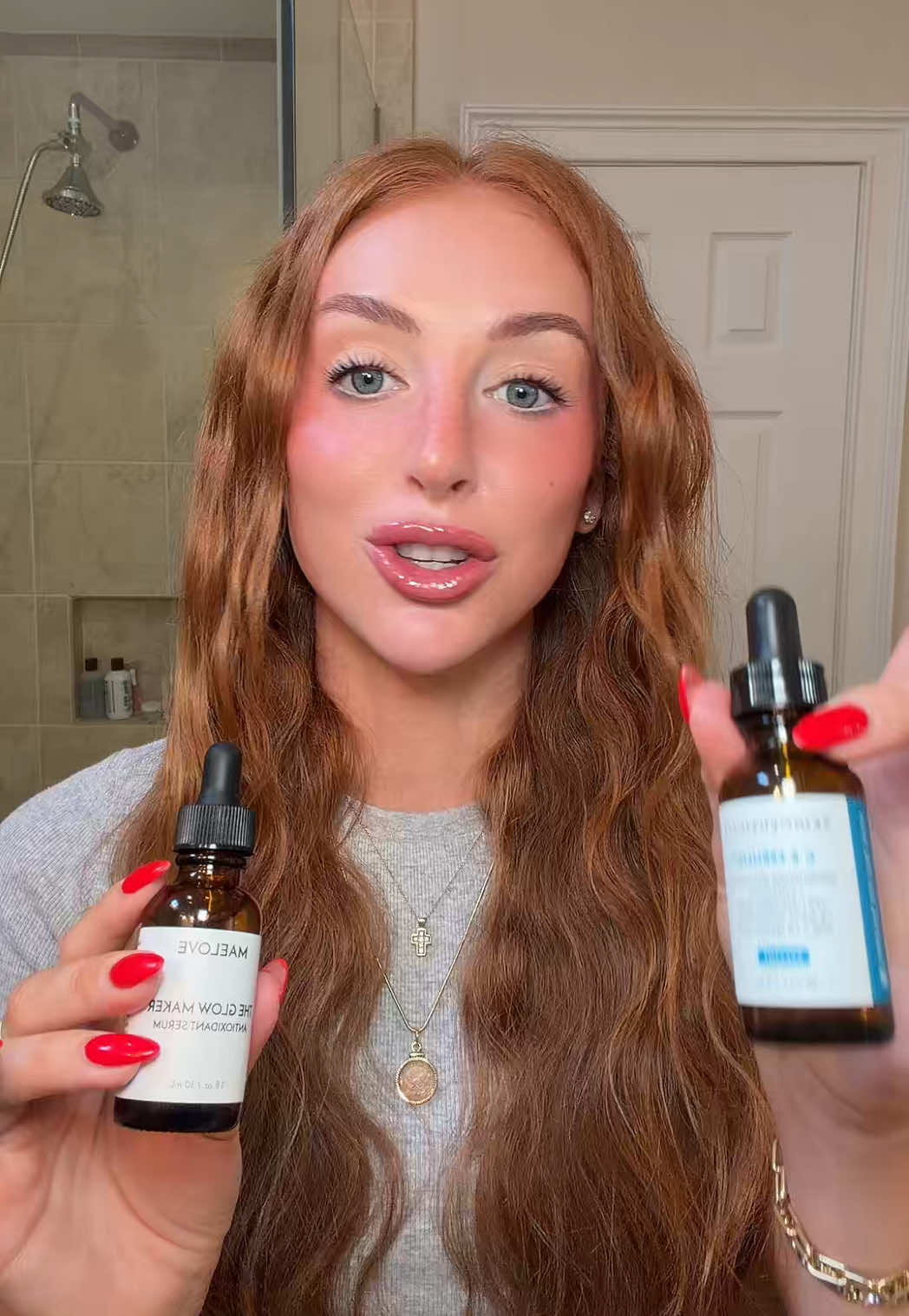
Hook: "POV: Just started using Glow Maker and..." spoken by a smiling creator holding the actual bottle. Why it works: The trailing, incomplete sentence creates a curiosity gap that forces a watch-through, and using a real, unpolished creator instead of a model reads as peer testimony, which matters for a "dupe" product that needs to earn trust rather than assert luxury. Run this play: Expanded as Play 2 below.
- Running
- 59 days (longevity = it's converting)
- Hook
- "POV: I kept buying more skincare products for my wrinkles because I thought I just hadn't found the right one yet." + Woman touching forehead wrinkles.
- CTA / offer
- 100 day money back guarantee
- Audience
- Women with 'skin over 50' (explicitly stated at 0:17) concerned with wrinkles and dark spots.
Why it works. Verbalizes the exact frustrated buying pattern the audience already recognizes in themselves, building rapport before the product appears.
Visualizing the 'Skincare Graveyard' (0:08) Write your opening line as the exact internal thought your frustrated repeat-buyer customer has already had.
- Running
- 53 days (longevity = it's converting)
- Hook
- "How to use your vitamin C serum" text overlay with a woman in a beige bathrobe with white trim holding a bottle of Maelove The Glow Maker.
- CTA / offer
- "so go check it out."
- Audience
- Skincare enthusiasts who use multi-step routines, evidenced by the discussion of "cleansing and toning" and "layering on your other serums."
Why it works. Answers a concrete, practical question existing owners already have, building trust without a hard sell.
Educational 'How-To' Hook at 0:00: 'How to use your vitamin C serum' Turn your product's most common usage question into a short, direct how-to video hook.
- Running
- 66 days (longevity = it's converting)
- Hook
- "these are my go to in the mornings" spoken by a woman in black medical scrubs holding a blue serum bottle.
- Audience
- Skincare enthusiasts seeking professional validation (evidenced by the 'Board Certified Dermatologist' title and scrub uniform).
Why it works. Frames the products as an established daily habit rather than a first impression, which reads as more credible.
Authority Anchoring (0:05) Describe your product as part of your daily 'go-to' routine instead of reviewing it as something new you tried.
Show 7 more exhibits
- Running
- 65 days (longevity = it's converting)
- Hook
- "POV: Just started using Glow Maker and..." + Woman holding a brown bottle of Maelove The Glow Maker serum with a dropper.
- Audience
- Women in relationships (mentions 'Husband') seeking improved skin radiance.
Why it works. The unfinished POV sentence creates a specific gap about the result right after naming the exact product.
POV text overlay at 0:00: 'POV: Just started using Glow Maker and...' End your opening sentence right after naming your product, leaving the outcome unstated to pull viewers into the rest.
- Running
- 2 days (new — still being tested)
- Hook
- "I tried vitamin C before and it burned" + a dropper dripping clear liquid into a brown glass bottle with white text bubbles appearing.
- CTA / offer
- "Would you finally try Glow Maker?"
- Audience
- People with sensitive skin who want vitamin C benefits but fear irritation ("we take sensitive skin seriously").
Why it works. Leads with the viewer's own doubts, including a direct Skinceuticals comparison, so skeptical sensitive-skin shoppers feel understood before the sell starts.
Objection-led Hook (0:00 - "I tried vitamin C before and it burned") Open your video with the two most common skeptical questions your prospects ask, verbatim as on-screen text bubbles, before pitching anything.
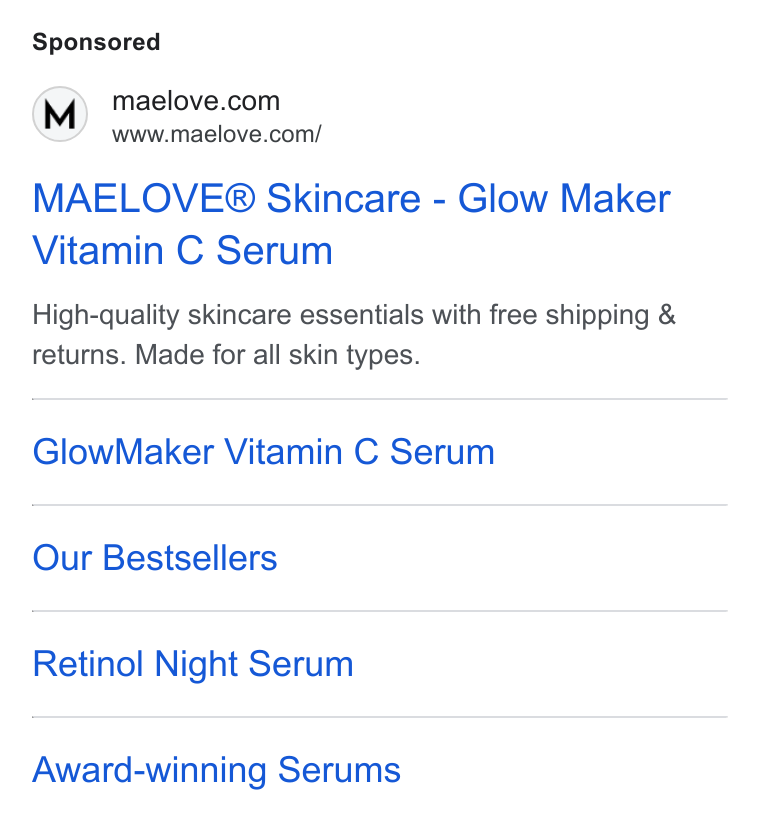
- Running
- 771 days (longevity = it's converting)
- Hook
- Sponsored maelove.com M www.maelove.com/ MAELOVE® Skincare - Glow Maker Vitamin C Serum
- CTA / offer
- High-quality skincare essentials with free shipping & returns.
- Audience
- Individuals interested in skincare, specifically those looking for Vitamin C serums, anti-aging solutions (Retinol), and general high-quality skincare products, as indicated by the product names and the phrase 'Made for all skin types.'
Why it works. Naming the product line and its hero ingredient in one headline qualifies searchers who already know what they want.
Headline with product name and key benefit: 'MAELOVE® Skincare - Glow Maker Vitamin C Serum' Put your product name and hero ingredient in the same headline so search shoppers self-select before clicking.
UGC talking-head
- Hook
- "If you're struggling with dark spots hyperpigmentation that was acne in the" - A woman with long brown hair, wearing a black top, is speaking directly to the camera in a bathroom setting.
- Audience
- Individuals struggling with hyperpigmentation, dark spots, melasma, or uneven skin tone, as explicitly stated in the hook and throughout the video.
Why it works. Opens by naming the precise cause, acne scarring rather than sun or age spots, so viewers with that exact history recognize themselves before the routine appears.
Problem-agitation hook with direct address (0:00-0:10): "If you're struggling with dark spots hyperpigmentation that was acne in the past melasma or just want to even out your skin tone get rid of some of those little dark spots but you're not really sure what to look for" Open your UGC script by naming the specific cause behind your customer's problem, not just the visible symptom.
- Hook
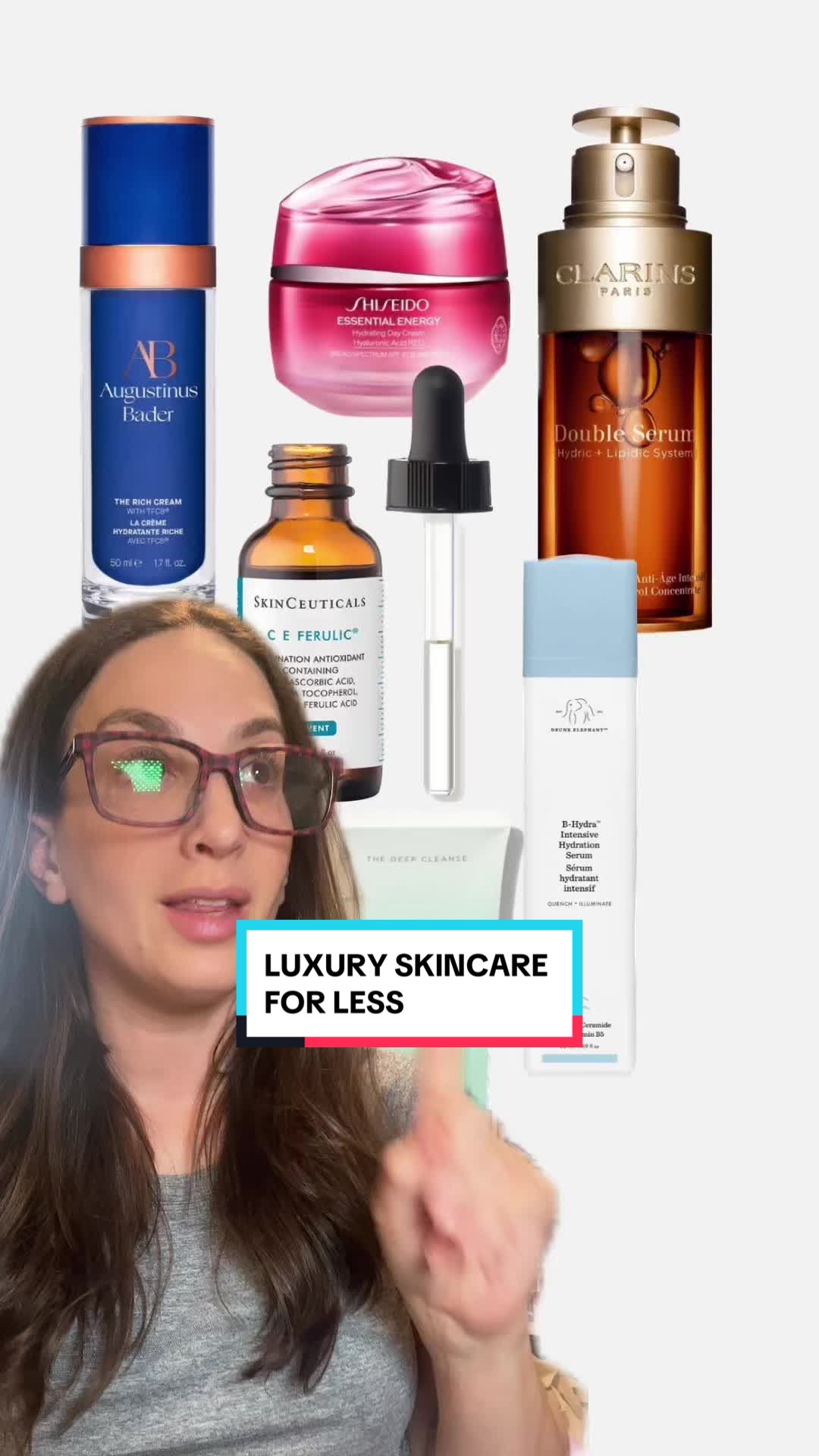
- "This one is for my girls that have champagne taste but a beer budget because I totally understand." A woman with long brown hair and glasses is speaking directly to the camera, with several skincare product bottles and tubes floating around her head.
- Audience
- The opening line, "This one is for my girls that have champagne taste but a beer budget," directly signals the target audience as individuals who desire high-quality skincare but are budget-conscious. The comparison to expensive brands further reinforces this.
Why it works. Naming a specific budget-versus-taste tension and addressing an in-group builds relatability before any product appears, positioning Maelove as the affordable-luxury pick.
Problem-solution framing + anchoring (0:00-0:14) Open your UGC with a relatable money tension your audience feels, then position your product as the resolution before naming it.
- Reach
- 100 upvotes · 40 comments · r/SkincareAddiction
A community is already discussing this in r/SkincareAddiction. Show up there authentically and answer the thread before a competitor does.
Who amplifies them
The amplification layer splits cleanly into three groups. The brand's own TikTok account (@maeloveskincare) posts product-focused clips like the Fade Away discoloration serum explainer. Formal creator partners carry the #maelovepartner tag, including @Abbythebadassmom and CATE SILVEIRA (UGC CREATOR), both openly tagged as brand partners rather than unpaid fans. A wider ring of unpaid or lightly-incentivized creators drives organic reach: @BrigJean, @BeautyJM, @Alexandra Helene (who links Maelove through her ShopMy page), and Reddit's krazydoglady, whose two-part 2019-2020 review series switching from SkinCeuticals to Maelove is the earliest documented instance of the brand's core positioning taking hold in public. No verified personal founder social account was found in this dataset. Jackie Kim's public-facing presence here is entirely through the brand's own YouTube channel, not a separate personal following.
07 Organic & video
The organic content engine: the videos, creator posts, and community presence earning attention without paid spend.
The owned YouTube channel runs on founder-hosted, long-form science explainers, Jackie Kim walking through topics like collagen, niacinamide stability, and retinoid pairing, each capped with a link to a written guide. Creator UGC on TikTok follows a different register: short, POV-style clips built around a genuine hand holding the actual bottle. The top three by engagement are BrigJean's first-impressions clip (4,491), Abbythebadassmom's "luxury skincare without the luxury price" post tagged #maelovepartner (2,061), and BeautyJM's comparison video pitting Maelove against Medik8 as budget alternatives to a pricier system (1,197). On Instagram, a dermatologist's derm-approved AM/PM routine reel from samarapollockmd (2,202 engagement) stands out as the account's strongest third-party post. The format that consistently performs across platforms is the same one: a real person holding the actual bottle, speaking to a specific skin concern rather than a polished lifestyle shot.
08 Affiliate & partners
How the brand turns creators and partners into a tracked, variable-cost acquisition channel, and how the program is structured.
Affiliate is Maelove's second-largest traffic channel at 19.7%, evidenced concretely by a TikTok Shop presence (one creator explicitly flags "TikTok Shop also has coupons available"), creator links through ShopMy and Linktree, and the #maelovepartner tag marking a real, if not publicly documented, creator affiliate program. A separate signal surfaced in a Black Friday creator post: a "Family Circle" subscribe-and-save offer giving 20% off on subscriptions of 3+ items, a recurring-purchase mechanic not otherwise visible in their public single-SKU pricing. No dedicated affiliate program page was found linked from the homepage itself, so the mechanics run through creator relationships and platform-native shopping (TikTok Shop) rather than a self-serve public sign-up.
09 The playbook
The channels are not separate. They are one system where each stage feeds the next. Here is the read, then the plays to run tomorrow.
The inferred playbook
Maelove converted one positioning wedge, an ingredient-matched dupe of a $180+ prestige serum at $32.95, into a machine where organic trust still outweighs paid volume, even as its ad libraries have scaled to 86 active units.
The 2019 positioning against SkinCeuticals C E Ferulic still shows up everywhere: it seeded the earliest Reddit reviews, it is the subject of a dedicated organic-ranking blog page, and its logic (match the actives, undercut the price) still underlies bold-claim ad copy like "Your 40s will thank you" years later.
At 19.7% of total traffic, affiliate outperforms both paid search and paid social combined, run through TikTok Shop, creator ShopMy links, and a partner tag rather than a public program page, converting UGC reach directly into purchases instead of just impressions.
Dig deeper+3▾
Jackie Kim's 22-video YouTube library of ingredient explainers (source) functions as content marketing that reinforces the same "we out-formulate the luxury brands" claim the paid creative leans on, without a separately articulated growth strategy behind it (source).
The "maelove shampoo" keyword (1,070 searches/mo) and a cluster of Google ads for a "Full Follicle" and "Growth Factor" hair line show the same affordable-efficacy positioning being extended into hormonal hair thinning, a new category tested on the back of the same trust asset.
free-to-paid conversion (no subscription tier exists to convert into), churn, CAC, and blended order-level ARPU.
Position as the science-backed dupe of a category leader
The proofMaelove's entire growth story traces back to a documented ingredient match against SkinCeuticals, still their #1-ranking search term and still the frame behind ad claims like "Your 40s will thank you."
The adaptationPick the closest premium incumbent in your own category, publish a direct spec or ingredient comparison page on your own site, and show up honestly in the forums or subreddits where people already discuss that incumbent with real data, not a sales pitch. This works because buyers trust a comparison they can verify more than a superlative claim, provided the underlying match is genuinely defensible.
Cost: $0 · Time to signal: weeks · Works pre-PMF: yes, provided the comparison holds up to scrutiny; a weak dupe claim gets torn apart in the same communities that would otherwise champion it.
Host your own founder-led education content
The proofJackie Kim personally hosts Maelove's 22-video YouTube library of skincare-science explainers, one reaching nearly 26,000 views, each linking to a deeper written guide on the company's own site.
The adaptationRecord yourself explaining the mechanism behind your own product category on video, not a scripted ad, and pair every video with a written companion post on your own domain so the same content earns both trust and search ranking. Do this even before you have a marketing budget; it costs only your own time and camera.
Cost: $0 · Time to signal: weeks · Works pre-PMF: yes.
Recruit a creator affiliate layer before you can afford paid
The proofAffiliate traffic is Maelove's second-largest channel at 19.7%, built through TikTok Shop tags and a #maelovepartner creator network rather than a publicized program.
The adaptationSet up a lightweight affiliate or rewards link through whatever commerce platform you already use, then personally reach out to a handful of micro-creators who already talk about the incumbent product in your category, offering commission or free product in exchange for an honest review. The mechanism is that creators already have earned trust with an audience primed for exactly your comparison.
Cost: under $500 · Time to signal: weeks · Works pre-PMF: yes, provided you have inventory to gift and a real basis for creators to prefer it.
Turn one winning hook into a creative family
The proofMaelove's "5-minute routine" concept runs simultaneously as a text-heavy ad, a product shot, and two testimonial variants targeting busy parents, all active at once rather than replaced one at a time.
The adaptationOnce you find a hook that resonates (through organic posts, customer language, or an early ad), don't just scale the winning format; rebuild the same core idea across three or four different formats (a demo, a testimonial, a bold-claim graphic) and run them together to find which execution, not just which message, performs. Weeks of parallel testing tell you far more than the same one ad running longer.
Cost: under $500 · Time to signal: weeks · Works pre-PMF: conditional, only once you already have one message that's proven to convert; testing formats before you have a working hook wastes the budget.
Extend an established trust asset into an adjacent problem
The proofMaelove is testing a hair-thinning line (Full Follicle, Growth Factor Hair Serum) through Google ads and a "maelove shampoo" keyword now pulling over a thousand searches a month, extending its affordable-efficacy story into a new but adjacent pain point.
The adaptationIdentify one adjacent problem your existing product's trust story is credible for, then test real demand with a single landing page and a small search-ad budget on that adjacent keyword before committing to a full product build. This lets you validate the extension cheaply against actual search intent instead of guessing.
Cost: under $500 · Time to signal: weeks · Works pre-PMF: conditional, this only works once your core product already has a credible trust asset worth extending; there's nothing to leverage before that. Maelove's current scale, an 86-ad footprint spread across three platforms and the budget that implies, assumes unit economics a pre-PMF founder hasn't proven yet. The transferable part of this teardown is the early motion: the dupe positioning, the founder-hosted content, and the creator-affiliate layer, all of which cost nothing and predate the paid scale-up entirely.
You just read how Maelove Skincare does it. Tomorrow it is someone else.
Every morning we take one company that is actually growing and break down where its customers come from: the ads still running after a year, the channel doing the real work, and the play you can run this week.
Systemaic · directional intelligence. Traffic, spend, and reach figures are SimilarWeb-style estimates and qualitative reads of public data, not audited numbers. Built on real public receipts.
// teardowns with a similar GTM motion
sources & receipts (5)
Live ad libraries: meta ad library · google ad library
Founder interviews: What causes milia and how do you get rid of them · Large Pores: why they happen and what you can do about them. · Timeless vs MaeLove Glow Maker
Traffic, spend, and revenue figures are estimates as noted in the report; the links above are the primary public artifacts.