- 01Narrate the milestone, not the product
- 02Run a time-boxed output contest to generate product UGC
- 03Recruit income-narrative creators as your affiliate distribution layer
- 04Personalize cold B2B outreach with company-level social proof
01 Snapshot
The one-glance read on who they are and how they grow. Each point is verifiable from the receipts above.
Lovable (lovable.dev) is an AI full-stack app builder that turns natural language prompts into production-ready React/Supabase web apps, targeting non-technical founders, solopreneurs, and enterprise employees who need to ship without a developer; the company reported $200M ARR as of November 2025.
Launch-led at origin, now multi-motion: founder build-in-public on X, a creator affiliate army on TikTok, video-heavy paid acquisition on Google, and a distinct enterprise push via personalized LinkedIn InMail.
~34.8M estimated monthly visits, 66% arriving direct; approximately 6,000 total Google ad library entries with 240 active as of early July 2026; 50M+ projects created on the platform; 100K+ new projects per day (Q4 2025); 61 open roles.
"We launched publicly 8 days ago, hit $1M ARR today, and only took down one cloud provider along the way." (Anton Osika, co-founder and CEO, November 2024)
As of early July 2026, new Meta ad creatives are routing traffic to academy.lovable.app, signaling a new education or onboarding product being tested as an acquisition surface alongside the main sign-up flow.
Lovable built a $200M ARR machine on a compounding loop that started with open-source GitHub virality, converted through Anton Osika's milestone posts on X, then scaled through a TikTok creator affiliate army and a Google video ad blitz, all feeding a freemium product that needs zero sales motion to close its first conversion.
02 How it unfolded
The order the channels came online. Sequence is strategy: what they did first, and what they layered on once demand existed.
03 Traffic & channel mix
Estimated demand, the channel split behind it, and the keywords and referrers doing the work. Directional modeling, not audited analytics.
Traffic sources
Top search keywords
| Keyword | Volume | Weight | CPC |
|---|---|---|---|
| lovable | 2.5M | $1.03 | |
| loveable | 560k | $1.28 | |
| lovable ai | 486k | $0.93 | |
| loveable ai | 184k | $1.39 | |
| base44 | 1.1M | $1.87 |
Top referring sites
Closest competitors by audience
Lovable draws an estimated 34.8 million monthly visits, essentially flat over the observed window (-1.4% trend). The channel story is dominated by one number: direct traffic accounts for 66% of all visits, a figure reflecting the brand recall built across the open-source origin, $330M in announced funding rounds, and Anton Osika's ongoing build-in-public cadence. For a product with 50M+ total projects created, habitual return use and organic word-of-mouth both sustain this floor.
Organic search at 13.5% and paid search at 5.1% together account for roughly one-fifth of traffic. The demand behind Lovable's top branded keywords is substantial: "lovable" draws 2.5M monthly web searches, "lovable ai" draws 486K, and the misspelling variant "loveable ai" draws 184K -- Lovable ranks at or near the top for each. The competitive term "base44" (a rival platform) pulls 1.1M monthly searches, suggesting Lovable also captures users actively comparing platforms.
Social organic at 5% and referrals at 4.6% add another meaningful slice. The top referring domains include chatgpt.com and google.com, pointing to AI-assisted and search-driven discovery; hackertyper.com and sbstexas.com add unexpected referral traffic; and okta.com appears only as a minor referrer at roughly 1.8%. Gen AI referrals at 2.4% reflect AI assistants recommending Lovable in response to "how do I build an app" prompts. Display (1%), email (2.4%), and paid social (0.2%) together total under 4%.
04 Organic content
The specific pages earning their organic search traffic, and the pattern behind why they rank. Adapt the format, not the topic.
Lovable's top organic pages are almost entirely brand-owned utility surfaces: their AI integrations documentation page, the docs welcome and introduction page, the homepage, the pricing page, and the download page. The pattern is brand-capture, not discovery: the pages earning the most estimated organic search traffic are the ones users search after they already know the product name. There are no comparison pages or "alternative to X" entries in the top five.
This points to a specific structural choice: Lovable earns discovery through paid video, creator UGC, founder posts, and press, then relies on branded organic search to convert that awareness into a visit. The docs surface in particular functions as a retention and activation layer rather than a top-of-funnel acquisition channel, with the AI integrations page alone drawing an estimated 32K organic visits per month.
Top pages by organic traffic
05 Channel map
Not traffic share. How much weight the growth system actually puts on each channel, with a one-line read on the role it plays.
What drove growth
06 Who they’re hiring
Open roles read like a roadmap: the functions they’re staffing show where the company is investing next and what stage it’s at.
61 open roles
07 The motions doing the work
For founder-led SaaS the breakdown shifts from ads to traction: where the first users came from, how the founder grows it in the open, and the compounding organic surface.
Lovable's first users didn't come from a planned launch campaign; they came from open-source virality and a single well-timed relaunch on the day the product became commercially available.
Anton Osika built GPT Engineer as a side project in 2023, and it hit #1 on GitHub Trending almost immediately, giving the team an existing developer audience before any commercial product existed. That organic moment was both the proof of concept and the initial warm list.
Co-founder and CTO Fabian Hedin noted on X that independent power user Chris Messina posted the product without being asked, and it reached #1 on the platform, generating the first wave of non-developer sign-ups. The team didn't orchestrate this launch.
Dig deeper+2▾
On November 21, 2024, Anton Osika (posting as "antonoo") submitted "Show HN: An AI that reliably builds full-stack apps by preventing LLM mistakes," framing the public launch as a technical reliability breakthrough. The post earned 32 points and 13 comments -- a modest HN showing, but it established the technical credibility frame the product would carry into its early press.
Eight days after the public launch, Anton Osika posted on X that Lovable had hit $1M ARR. That post earned 1,343 likes and 274K views and became the story that drove the next wave of signups. Four weeks in, the follow-up post announcing "$4M ARR in 4 weeks, the fastest growing startup in Europe ever" earned 4,347 likes and 1.2M views, seeding every tech media piece that followed and establishing the velocity narrative the company would sustain for the next 18 months. ---
Anton Osika's personal X account (@antonosika, 81,651 followers) is the engine that turned every ARR milestone into an acquisition event.
The "$1M ARR in 8 days" and "$4M ARR in 4 weeks" posts together generated over 1.4M views with zero paid distribution. The posts work because they carry personality alongside the number: "only took down one cloud provider along the way" turned a near-disaster into brand equity and gave the posts a detail readers could quote when sharing.
Anton Osika regularly runs participation events from his personal account: a "$10K in Lovable credits to whoever builds the most impressive app in 7 days" competition drew 692 likes and 111K views in March 2026; a free-weekend announcement for all users drew 1,376 likes and 240K views in June 2025; a LinkedIn certification feature launch drew 524 likes in January 2026. Each event creates a UGC feedback loop: the mechanics generate user-built demos shared with the Lovable brand attached.
Dig deeper+1▾
The March 2026 out-of-home ad blitz across NYC, SF, and London was announced and amplified through Anton Osika's X account rather than a press release, converting physical billboard placements into shareable digital content for the founder's audience. Fabian Hedin (co-founder and CTO, @FabianHedin, 6,272 followers) posts less frequently and focuses on technical and operational context; his early Product Hunt discovery tweet is a representative example of the function his account serves. ---
Lovable's organic search presence at 13.5% of ~34.8M monthly visits is a real channel at this scale, but it is almost entirely a brand-capture surface built on demand generated elsewhere, not a discovery engine.
The top two organic pages are docs.lovable.dev/integrations/ai and docs.lovable.dev/introduction/welcome, collectively drawing an estimated 58K organic visits per month. These are activation and retention pages, not acquisition pages; they serve users who discovered the product through TikTok, a founder post, or a media article and are now learning to build.
A formal affiliate and partner program lives at lovable.dev/partners. The #lovablepartner TikTok creator activity shows the program operates as a content-creator affiliate network: creators earn referral income by building client projects and posting about the process, with the partner link as the attribution mechanism. This is a distribution layer that compounds independently of any content Lovable itself produces.
Dig deeper+3▾
As of early July 2026, Lovable runs approximately 240 active Google ads across a library of roughly 6,000 total entries. The proven winners, running since October 2025, are all video format with the longest active at ~273 days. The creative through-line across Meta proven winners is a single message in multiple executions: "It used to cost $10K+ to build an app. Now you can do it yourself." A variation leads with "This used to take over 6 weeks to build." Both anchor a category-creation argument -- replacing a developer engagement, not competing with another tool -- and speak directly to the non-technical founder audience. Text-format Google ads launched in June 2026 represent the first format test outside video.
The 24 active LinkedIn ads as of early July 2026 run a company-personalized InMail playbook: each message opens with "Hi %FIRSTNAME%, teams at %COMPANYNAME% are already using Lovable to build [role-specific tool]," implies peer adoption at the recipient's employer, offers a $25 first-month discount exclusive to that company's employees, and closes with a time-limited validity window. The format is designed to make a single non-technical employee feel their colleagues are already inside and they are the last to try it.
The newest Meta ad tests route to academy.lovable.app rather than the main product, suggesting a structured learning funnel is being tested as a lower-friction first step than "start building right now." ---
08 Paid ads
This founder-led SaaS also runs paid acquisition. Here are the live ads doing the work, each with the X-ray and a play you can adapt.
- Running
- 18 days (longevity = it's converting)
- Hook
- "I genuinely thought you had to be a developer" spoken by a blonde woman in a black strapless dress holding a small black microphone in a park.
- CTA / offer
- "try Lovable today"
- Audience
- Non-technical entrepreneurs or 'idea people' who feel blocked by coding requirements ("I genuinely thought you had to be a developer").
Why it works. A relatable UGC testimonial format lends peer credibility to the idea that building an app used to feel impossible, aimed at aspiring non-technical creators.
Confessional Hook (0:00 - "I genuinely thought you had to be a developer") Cast a relatable, non-technical presenter to say the exact hesitation your prospects feel before showing them the fix.
- Running
- 16 days (longevity = it's converting)
- Hook
- "This is Lovable." + The Lovable logo (a heart with a pink-to-orange gradient) and the word "Lovable" in white text centered on a dark background with a pink and blue glow at the bottom.
- Audience
- Aspiring app creators or non-technical founders (indicated by the prompt "Create an AI resume builder").
Why it works. A bare brand-name reveal works as a teaser for audiences who have never heard of Lovable, letting the mystery of the name carry them into the next frame.
Direct prompt demonstration at 0:01 showing 'Create an AI resume builder' being typed. Open with your product name alone on screen for the first beat, no tagline, before cutting to the interface.
- Running
- 5 days (new — still being tested)
- Hook
- "I charged $7000 for this app" + man in a black quarter-zip sweater talking to a microphone with purple and orange background lighting.
- CTA / offer
- "Try Lovable for free"
- Audience
- Freelancers and aspiring founders looking to build software without coding (mentions "charging $7000" and shows a "coaching dashboard").
Why it works. A founder states a specific, if redacted here, price he once charged for similar app work, building credibility that AI can now do that paid job.
Financial Outcome Anchoring (0:00 - "I charged $7000") Have your founder state a specific real number tied to a past cost or result on camera, as the opening line, before revealing the product.
Show 3 more ads
- Running
- 4 days (new — still being tested)
- Hook
- "HAVE ANY DREAMS?" Man with a microphone interviews two women on a sidewalk at night.
- CTA / offer
- "GO TO LOVABLE!!"
- Audience
- Aspiring entrepreneurs or 'idea people' who have app concepts but lack technical skills, signaled by the 'Uber for boats' prompt.
Why it works. A deadpan street-interview question about dreams plays as a joke before the reveal, reaching younger scrollers who'd skip a straightforward pitch.
Street interview format (0:00-0:06) asking 'HAVE ANY DREAMS?' Try a deadpan, slightly absurd interview-style question as your hook before pivoting into the product demo, to reach viewers who'd skip a direct pitch.
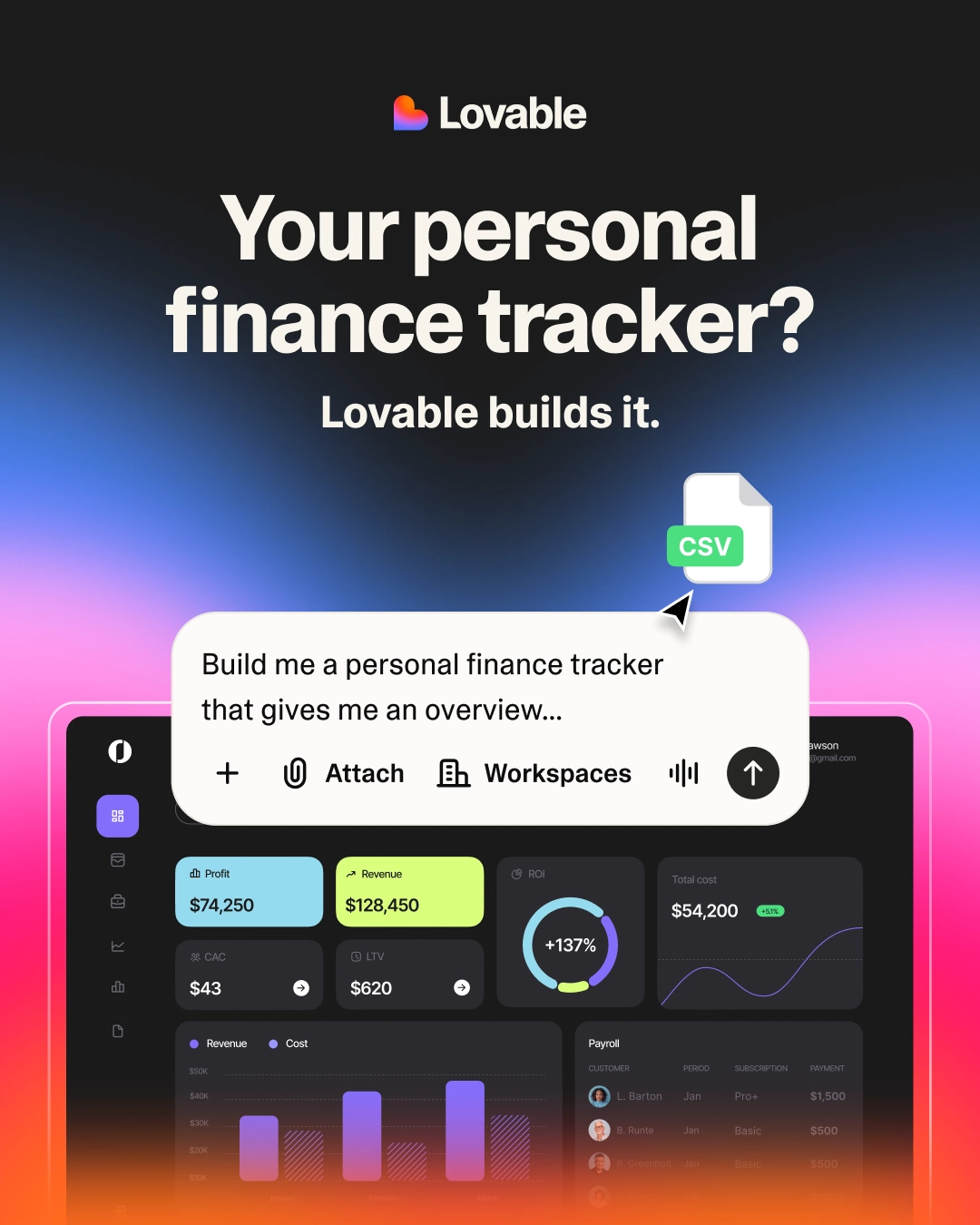
- Running
- 17 days (longevity = it's converting)
- Hook
- On-screen text reads "Your personal finance tracker? Lovable builds it." with the Lovable logo at the top.
- Audience
- Individuals or small businesses seeking to manage their finances, indicated by the terms "personal finance tracker," "Profit," "Revenue," "CAC," "LTV," "ROI," and "Payroll" on the dashboard.
Why it works. Names a concrete, relatable project, a personal finance tracker, so viewers with that exact unmet need see themselves in the ad instantly.
Directly addressing a common problem with a question and immediate solution in the headline: "Your personal finance tracker? Lovable builds it." Pick one specific, relatable use case your audience wants solved, phrase it as a question, then answer with your brand in the same beat.
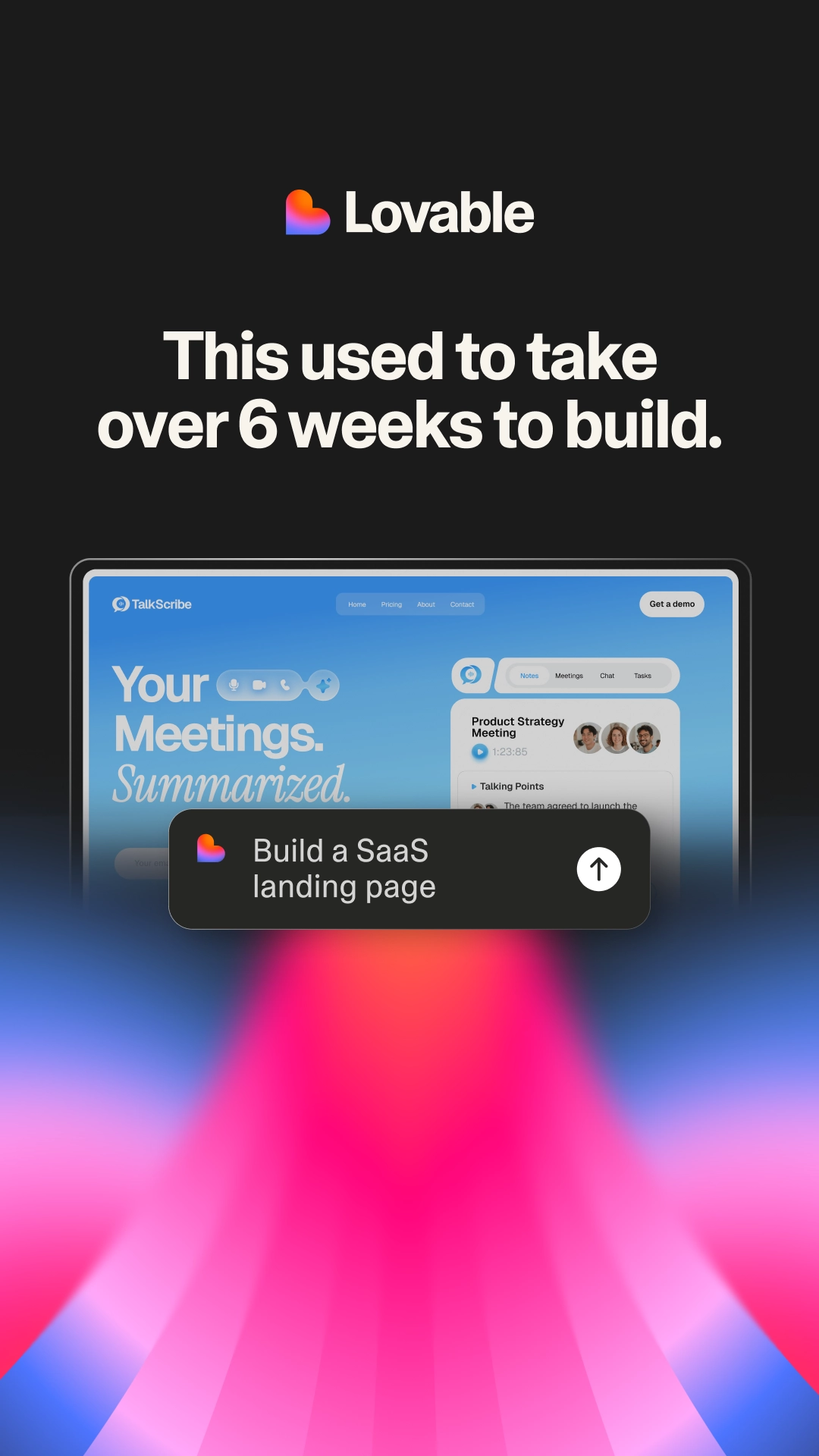
- Running
- 17 days (longevity = it's converting)
- Hook
- On a dark background, the word "Lovable" with a heart-shaped logo appears at the top. Below it, large white text reads: "This used to take over 6 weeks to build."
- CTA / offer
- Get a demo
- Audience
- Entrepreneurs, product managers, or developers looking to quickly build and launch SaaS products or landing pages, indicated by "Build a SaaS landing page" and the "TalkScribe" app interface.
Why it works. Swaps the campaign's usual cost anchor for a six-week time anchor, aimed at SaaS founders and product teams who weigh speed to launch over price.
Bold, quantifiable claim as headline: The text "This used to take over 6 weeks to build." is prominently displayed. Run a second version of your cost-anchor ad that anchors on time saved instead of money saved, to see which objection your audience responds to more.
09 The playbook
The channels are not separate. They are one system where each stage feeds the next. Here is the read, then the plays to run tomorrow.
The inferred playbook
Lovable's acquisition loop is a three-stage compounding machine: open-source virality created a warm developer audience, the founder's X posts converted that audience into paying users by narrating velocity in real time, and a creator affiliate army then carried the product to a non-technical audience the founder's X account could never reach alone.
GPT Engineer's GitHub virality gave the founding team an audience before the commercial product launched. Anton Osika's X milestone posts converted that audience into early paying users and into the media stories that generated the next cohort. Each milestone post was a mini launch.
The free tier (5 build credits/day) functions as a try-before-you-buy entry point, letting non-technical users build something tangible before hitting a paywall. The credit model creates a natural upgrade moment: users mid-build and out of credits face a high-intent conversion decision at exactly the moment the product has demonstrated value. Paid tiers start at $25/month (Pro) and $50/month (Business).
Dig deeper+3▾
The #lovablepartner TikTok program converts the "I made money building apps" narrative into a scalable distribution surface without Lovable producing the content. Creators earn by building client websites; their posts demonstrate product output quality while pitching the side-income angle to an audience of non-technical operators who would never have seen the founder's X posts.
The LinkedIn InMail campaign, running since June 2026, targets individual employees at named companies with the social-proof frame that their colleagues are already building with Lovable. This is a bottom-up enterprise motion: convert individuals, accumulate usage within a company, then sell a Business or Enterprise plan to the team.
Free-to-paid conversion rate, churn, CAC by channel, blended ARPU across tiers. ---
Narrate the milestone, not the product
The proofAnton Osika's "$1M ARR in 8 days" post and the "$4M ARR in 4 weeks" follow-up together drew over 1.4M views with zero paid distribution, each post leading with velocity and a self-deprecating detail rather than a feature announcement.
The adaptationWhen you hit a genuine milestone (first $1K MRR, first 100 users, first paying customer outside your network), post it as a single sentence with one surprising or self-deprecating detail. The format is: [number] in [time] + one honest clause about what actually happened. Write a short thread explaining the real mechanism, not the polished version. Post from your personal account. The detail is load-bearing: "only took down one cloud provider" gave readers something specific to quote when sharing; a bare number alone doesn't give people a reason to repost. First step: draft the milestone post before you hit the milestone, so you ship it within hours rather than days of the event.
Cost: $0 · Time to signal: days · Works pre-PMF: yes
Run a time-boxed output contest to generate product UGC
The proofThe "$10K in Lovable credits to whoever builds the most technically impressive app in 7 days" post drew 692 likes and 111K views in March 2026, and generated a feed of user-built demos shared publicly with the Lovable brand attached. The prize was denominated in product credits, not cash.
The adaptationOffer something meaningful to your early users -- extended access, a feature unlock, a cash prize if margins allow, or even a public shoutout to a named-customer-size audience -- in exchange for building something with your product and sharing it publicly in a 7-day window. The judging criterion should be specific enough that participants know what to optimize for. Post the contest from your personal account, set a clear entry mechanic (quote-post with a demo link, or tag the brand), and let the replies become the content feed. This works for any tool where the output is shareable and the builder can be proud of the result. Start by defining what "impressive" means in your category before posting; vague judging criteria produce vague entries.
Cost: $0 to under $5k depending on prize value · Time to signal: days · Works pre-PMF: conditional (requires a product that produces demonstrable output users feel proud sharing; utility tools with no visible output will not generate the UGC volume needed for the loop to work)
Recruit income-narrative creators as your affiliate distribution layer
The proofThe #lovablepartner TikTok creator program scales without Lovable producing content: creators film themselves building client websites and charging $800 to $1,000, with the product appearing as the efficiency tool that makes the rate possible. Posts in the 2.2K to 79K engagement range circulate without production cost to the brand, and the affiliate infrastructure lives at lovable.dev/partners.
The adaptationIdentify the outcome your product enables that someone would brag about -- a freelance rate, a client win, a time save that translated into dollars. Reach out to mid-tier creators (10K to 100K followers) in that niche and offer early or free access plus a referral commission in exchange for one honest post about the result they personally got. The creator must have actually used the product and gotten the outcome; scripted testimonials in this format perform far below authentic income-claim content. Minimum infrastructure before outreach: a dedicated partner landing page, clear commission terms, and a trackable referral link. First step: sign up two to three real users who have already achieved the outcome and ask them to post about it before you build the formal program.
Cost: under $500 to set up the infrastructure, plus referral commissions · Time to signal: weeks · Works pre-PMF: conditional (the outcome must be real and the creator must have genuinely achieved it; a product with no clear income or time-save angle will not generate credible income-narrative content)
Personalize cold B2B outreach with company-level social proof
The proofLovable's LinkedIn InMail ads open with "Hi %FIRSTNAME%, teams at %COMPANYNAME% are already using Lovable to build [role-specific tool]" and close with a discount "exclusively for %COMPANYNAME% team members." The format implies peer adoption at the recipient's employer, making inaction feel like falling behind rather than a neutral choice.
The adaptationWhen reaching out cold to potential customers at companies, check first whether anyone at that company is already using your product (free tier, trial, or paid). If they are, lead with that fact: "A few people at [Company] are already using [Product] to [specific outcome]." Then offer something exclusive to that company's team -- a group discount, a dedicated onboarding call, or priority access to a feature. The social proof works because it is specific: "teams at your company" is more credible than "thousands of companies trust us." Start by identifying your highest-density company clusters (the industries or geographies where you already have multiple users at the same firm) and send the first 10 messages manually before automating anything. This play does not work with fabricated social proof; the claim must be accurate or it will damage trust on first reply.
Cost: $0 using email or LinkedIn free InMail credits · Time to signal: weeks · Works pre-PMF: no (requires at least a few real users at recognizable companies to name as social proof)
Test an education landing page as a lower-friction paid acquisition destination
The proofAs of late June 2026, Lovable's newest Meta ad tests route to academy.lovable.app rather than the main product sign-up page, suggesting the company is positioning a structured learning experience as an easier first step than "start building something right now." The destination is new enough that its conversion mechanics are not yet public -- but the fact that Lovable is routing paid traffic there indicates a deliberate funnel test.
The adaptationIf your core product has a steep onboarding ramp or requires the user to arrive with a specific problem in mind, build a framed learning experience -- a short course, a guided challenge, or a step-by-step tutorial series -- that lets users get value from the tool while building something low-stakes. Host it on a dedicated subdomain and route a portion of your paid acquisition there rather than to the main sign-up page. The mechanism: a learning-path entry reduces the "I don't know where to start" paralysis that kills trial activation, and creates a structured moment of demonstrated value before any credit or trial limit is reached. First step: build one tutorial-path landing page and run it as an A/B test against your existing sign-up page destination; measure whether trial-to-activation rates differ before investing in a full academy build.
Cost: under $500 to build the first tutorial landing page · Time to signal: weeks · Works pre-PMF: yes, provided the tutorial delivers a visible, shareable output within 30 minutes Lovable's scale-era motion -- the $10K credit prizes, the out-of-home ads across three cities, the 6,000-entry Google ad library, and the LinkedIn enterprise InMail at volume -- requires a product with genuine word-of-mouth velocity, a large existing user base, and a funded media budget. The five plays above extract the early-stage mechanics Lovable ran before any of that scale was in place.
You just read how Lovable does it. Tomorrow it is someone else.
Every morning we take one company that is actually growing and break down where its customers come from: the ads still running after a year, the channel doing the real work, and the play you can run this week.
Systemaic · directional intelligence. Traffic, spend, and reach figures are SimilarWeb-style estimates and qualitative reads of public data, not audited numbers. Built on real public receipts.
// teardowns with a similar GTM motion
sources & receipts (9)
Live ad libraries: meta ad library · linkedin ad library · google ad library
Launch archives: Hacker News: Omg.lol – A lovable web page and email address · Hacker News: Open Lovable · Hacker News: How to Build a Minimum Lovable Product · Hacker News: Is Lovable getting monetization wrong? · Hacker News: Vibe coded Lovable-hosted app littered with basic flaws expo · Hacker News: Alternative to the MVP: Simple, Lovable and Complete
Traffic, spend, and revenue figures are estimates as noted in the report; the links above are the primary public artifacts.