- 01Watermark every free output
- 02Pair a milestone post with a first demo
- 03Boost your best personal post instead of writing ad copy
- 04Let affiliates bid on your own brand name
01 Snapshot
The one-glance read on who they are and how they grow. Each point is verifiable from the receipts above.
AI tool that turns a prompt into a designed presentation, document, or website for individual professionals and teams, flagged as a tier-1 momentum signal.
Organic-led and founder-led: word-of-mouth from free-tier watermarked exports, with Google and LinkedIn ads layered on top for brand defense.
70M+ users and $100M+ ARR as of November 2025, a $2.1B valuation on just ~$87M raised, plus roughly 900 active Google ads.
As of July 3, 2026, LinkedIn tests push the new Gamma Agent and a Claude integration, while fresh Google text ads route through Thai, Vietnamese, and Brazilian advertiser accounts.
The free "Made with Gamma" watermark on every export turns each shared deck into a visible ad, compounding reach without matching spend to a typical AI unicorn's funding.
02 How it unfolded
The order the channels came online. Sequence is strategy: what they did first, and what they layered on once demand existed.
03 Traffic & channel mix
Estimated demand, the channel split behind it, and the keywords and referrers doing the work. Directional modeling, not audited analytics.
Traffic sources
Top search keywords
| Keyword | Volume | Weight | CPC |
|---|---|---|---|
| gamma | 2.8M | $0.19 | |
| gamma ai | 1.6M | $0.20 | |
| gamma app | 427k | $0.19 | |
| гамма | 156k | $0.13 | |
| gama | 261k | $0.22 |
Top referring sites
Closest competitors by audience
Gamma pulls an estimated 30.7 million monthly visits, down 3.1% over the trailing 3 months, still enormous scale for a self-serve tool with no dedicated sales motion. Direct traffic leads the mix at 50%, followed by search organic at 31.4% and paid search at 5.6%; social organic (4.1%) and referrals (3.6%) trail, while Gen AI referrals, email, display, affiliate, and paid social together account for under 6% combined.
The dominant keywords are all branded: "gamma" draws 2.75M searches a month, "gamma ai" 1.55M, and "gamma app" 427K, meaning most of the demand Gamma ranks for is people who already know the product name, a signature of a word-of-mouth engine rather than a category-education one. Top referrers include elama.ru (a Russian marketing/ad-management platform, likely agency traffic), force.com (Salesforce's domain, suggesting embedded or linked usage inside CRM workflows), and canva.com, its most direct competitor, whose presence as a referrer likely reflects comparison-shopping rather than any partnership. Its closest competitors span design-first tools (canva.com, slidesgo.com) and newer AI-agent rivals (manus.im, genspark.ai), underscoring that Gamma now competes as much against general AI agents as against presentation software.
04 Channel map
Not traffic share. How much weight the growth system actually puts on each channel, with a one-line read on the role it plays.
What drove growth
05 The motions doing the work
For founder-led SaaS the breakdown shifts from ads to traction: where the first users came from, how the founder grows it in the open, and the compounding organic surface.
Gamma's forum launch trail is thin; its real inflection came from rebuilding the entire product around AI and letting the free tier do the talking.
The earliest Gamma-specific Hacker News submission, "Gamma, write like a doc, present like a deck" (August 2022), drew just 17 points and 4 comments, and later attempts in October 2022, March 2023, and May 2024 never cleared single digits either.
Co-founder Jon Noronha's October 2021 post announcing the company's roughly $7M seed round doubled as the first public product demo, pairing funding news with co-founder Grant Lee's introduction video on the same day to maximize reach from one announcement.
Dig deeper+2▾
Per company reporting, relaunching the product around AI generation in March 2023 took Gamma from roughly 60,000 users to 10 million within 9 months; the growth came from the product itself going viral, including a launch video, not a coordinated launch-day stunt across forums.
The team's own Show HN for the Gamma API public beta (September 2025) drew only 15 points and 3 comments, reinforcing that Hacker News has never been a primary discovery surface for this company.
Gamma's build-in-public engine runs through its co-founders' personal accounts and paid amplification of employee voices, not a single company mouthpiece.
Grant Lee, co-founder and CEO (alongside co-founders Jon Noronha and James Fox), posts from @thisisgrantlee to 42,918 followers across 2,843 posts, mixing career-vulnerability stories, a 2021 post on stock-option pain drew 941 likes and 69 quotes, with company milestones.
Jon Noronha posts from @thatsjonsense to 2,605 followers across 1,829 posts, a mix of product-management commentary and Gamma-specific updates, including the October 2021 seed-round announcement referenced above.
Dig deeper+1▾
Rather than relying on organic reach alone, Gamma runs LinkedIn ads tagged "Promoted by Gamma" behind employee and founder posts, such as one recounting the company's "biggest bet" to rebuild around AI and another from an operations lead about making documentation work for people, turning first-person storytelling into paid distribution instead of separately written ad copy.
Search is Gamma's second-biggest channel after direct traffic, and the ad spend behind it reads as brand defense more than demand generation.
The top keywords Gamma ranks and bids for are all its own name variants (detailed above), and no comparison, "alternative to," or template-directory pages surfaced in this data, so the SEO motion leans on owning the brand term rather than a built-out content library.
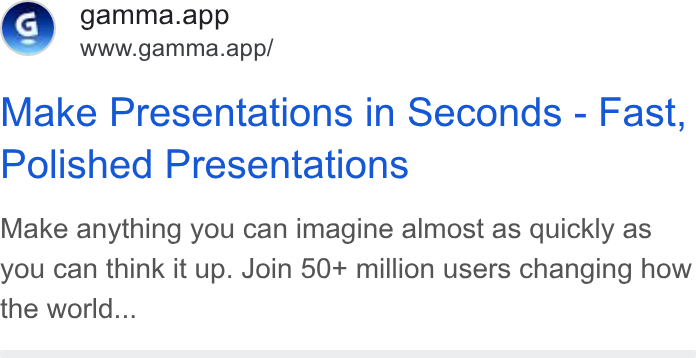
Roughly 900 active ads as of July 3, 2026, with the longest-running creative active 341 days; the actual ad units are sparse, mostly a blue "G" logo and headlines like "Make Presentations in Seconds - Fast, Polished Presentations," classic brand-term capture rather than a crafted demand-generation hook.
Dig deeper+2▾
The single longest-running "proven winner" ad (341 days) is run by an individual advertiser account rather than Gamma Tech, Inc. itself, and several other long-running ads trace to personal or small-business advertiser names across Vietnam, Brazil, and Hong Kong, consistent with an affiliate or reseller network independently bidding on "gamma" branded terms and routing clicks to gamma.app.
The roughly 46 active LinkedIn ads (detailed in Build in Public) show near-zero measured longevity across the board; LinkedIn functions as a rotating B2B feature-announcement and story-amplification channel rather than a sustained brand-term hold like Google.
06 Paid ads
This founder-led SaaS also runs paid acquisition. Here are the live ads doing the work, each with the X-ray and a play you can adapt.
- Running
- 259 days (longevity = it's converting)
- Hook
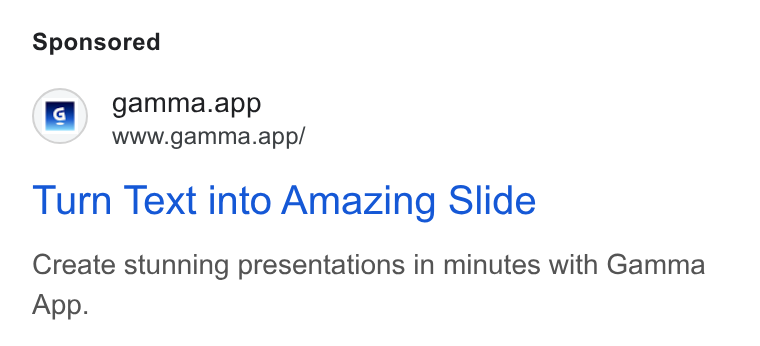
- Sponsored gamma.app www.gamma.app/ Turn Text into Amazing Slide
- Audience
- Individuals who need to create presentations quickly and easily, indicated by the phrases 'Turn Text into Amazing Slide' and 'Create stunning presentations in minutes'.
Why it works. Spells out the input-to-output transformation in four words, useful for searchers who don't yet know AI can do this and need the mechanism made concrete.
Headline stating a clear benefit: 'Turn Text into Amazing Slide'. State your product's transformation as Input to Output in your headline instead of a vague adjective like powerful or smart.
- Running
- 193 days (longevity = it's converting)
- Hook
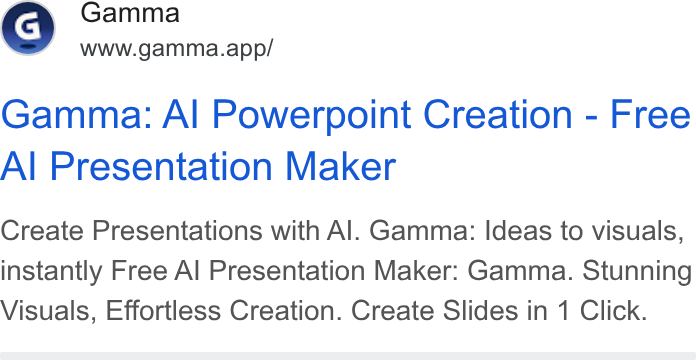
- Visual: A blue circle with a white 'G' logo on the left, next to the text "Gamma" and "www.gamma.app/". Text: "Gamma: AI Powerpoint Creation - Free AI Presentation Maker"
- Audience
- Individuals or professionals who need to create presentations quickly and easily, indicated by phrases like "AI Powerpoint Creation," "Free AI Presentation Maker," "Effortless Creation," and "Create Slides in 1 Click."
Why it works. Matches the searcher's own query language for presentation software while leading with Free, lowering the barrier for a first-time try from a budget-conscious searcher.
Headline clearly states the core offering and key benefit: "Gamma: AI Powerpoint Creation - Free AI Presentation Maker" Mirror your customer's exact search phrase in the headline and pair it with your lowest-friction offer like Free or No credit card.
- Running
- 179 days (longevity = it's converting)
- Hook
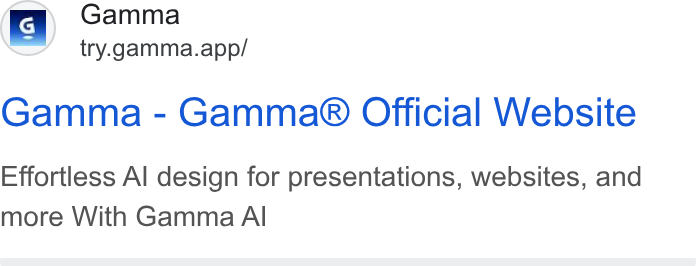
- Visual: A circular icon with a blue 'G' on a white background, next to the text "Gamma" and "try.gamma.app/". Below this, in large blue text, is "Gamma - Gamma® Official Website".
- Audience
- Individuals or businesses seeking easy and quick design solutions, indicated by "Effortless AI design".
Why it works. Targets brand-name searchers who already know Gamma and just need reassurance they're clicking the real site, not a competitor's lookalike listing.
Brand and URL display at the top (not visible) followed by a clear headline: "Gamma - Gamma® Official Website". If people already search your brand name, run a branded search ad that says Official Website to protect against copycat competitors bidding on your name.
Show 3 more ads
- Running
- 176 days (longevity = it's converting)
- Hook
- gamma.app www.gamma.app/ Make Presentations in Seconds - Fast, Polished Presentations
- Audience
- Professionals or anyone needing to create presentations, indicated by the focus on 'Presentations' and the promise of speed and polish.
Why it works. Targets time-pressed professionals by pairing an aggressive speed claim with a quality reassurance in the same headline, addressing the objection before it's raised.
Headline with a bold, quantifiable claim: 'Make Presentations in Seconds - Fast, Polished Presentations' When you claim speed, pair it in the same sentence with a quality word so prospects don't assume fast means sloppy.
- Running
- 173 days (longevity = it's converting)
- Hook
- www.gamma.app/ with a globe icon next to it, followed by "Gamma App AI PPT Creation" and "No code or design experience needed"
- Audience
- Individuals who need to create presentations but lack coding or design skills, indicated by "No code or design experience needed".
Why it works. Removes the two most common self-doubt objections, no design skill and no coding ability, directly in the headline for prospects who've never tried an AI tool before.
Directly states the core product function and benefit: "Gamma App AI PPT Creation". List the specific skills your prospect worries they lack, then state directly that your product doesn't require them.
- Running
- 1 day (new — still being tested)
- Hook
- gamma.app www.gamma.app/ Gamma Shop At Gamma.app To Transform Your Ideas Into Polished Presentations And Sites Right Now.
- CTA / offer
- Shop At Gamma.app To Transform Your Ideas Into Polished Presentations And Sites Right Now.
- Audience
- Individuals or businesses looking to create polished presentations and websites quickly, indicated by the text "Transform Your Ideas Into Polished Presentations And Sites Right Now."
Why it works. Broadens the pitch beyond presentations to include sites in one line, useful for showing prospects who only know Gamma for slides that it also builds web pages.
Direct call to action with benefit: "Shop At Gamma.app To Transform Your Ideas Into Polished Presentations And Sites Right Now." If your product does more than the one thing you're known for, name the second use case directly in a search ad headline.
07 The playbook
The channels are not separate. They are one system where each stage feeds the next. Here is the read, then the plays to run tomorrow.
The inferred playbook
The loop starts with the product itself: a free export that carries Gamma's name into someone else's inbox or slide deck, with paid and affiliate spend layered on to defend the name that loop creates.
Every free-tier export carries a "Made with Gamma" watermark, so each shared presentation, document, or website is a visible, clickable ad served to an audience the company never had to pay to reach, the mechanism behind the roughly 80% word-of-mouth growth the company has described and the scale referenced in the Snapshot above.
Pricing runs from a $0 Free tier (watermarked exports) to $8 Plus, $18 Pro, and roughly $100 Ultra per month, so the tier that mints the referral loop is a permanent part of the product, not a time-boxed trial, while the paid tiers monetize users who need extra credits, custom domains, or API access.
Dig deeper+3▾
The Google and affiliate-style bidding and the LinkedIn story amplification (detailed above) both point at people already searching the brand name or already in a founder's network, extending the loop's reach rather than generating new categories of demand.
No comparison pages, integration directories, or template libraries surfaced in this data, so if word-of-mouth ever slows, there is no visible owned-content asset compounding in the background to fall back on.
free-to-paid conversion rate, churn, CAC, and blended ARPU across the four pricing tiers.
Watermark every free output
The proofGamma's free-tier watermark on every exported deck, doc, or site is credited with roughly 80% of its word-of-mouth growth (see The Inferred Playbook), turning each share into a visible ad at zero added spend.
The adaptationWhatever your product outputs for free, a report, an image, an email footer, a generated invoice, add a small, visible, clickable credit line pointing back to your product. The mechanism is that distribution then scales with product usage instead of ad budget, since every free user's output becomes an impression for someone who isn't yet a user. Start by auditing every artifact your free tier produces and adding a credit line to the one with the widest external audience, the thing recipients, not just the creator, will actually see.
Cost: $0 · Time to signal: weeks · Works pre-PMF: yes, provided the free output is something a recipient other than the user actually sees.
Pair a milestone post with a first demo
The proofCo-founder Jon Noronha's seed-round announcement doubled as the company's first public product demo on the same day (see Launch & Traction), stacking two reasons to pay attention into one post.
The adaptationThe next time you have news worth a post, funding, a launch, a milestone, don't publish it alone; pair it in the same post or thread with a concrete first look at the product, a screen recording, a before/after, a real output. Start by drafting the next milestone post you'll need anyway and scripting a short demo clip to attach to it before publishing either separately.
Cost: $0 · Time to signal: days · Works pre-PMF: yes.
Boost your best personal post instead of writing ad copy
The proofGamma runs LinkedIn ads that are boosted founder and employee posts, tagged "Promoted by Gamma," rather than separately written ad creative (see Build in Public), turning organic storytelling directly into paid reach.
The adaptationFind the personal post, yours or a teammate's, with the best organic engagement over the past quarter and put a modest budget behind boosting that exact post rather than briefing new ad creative. Start by ranking your last 90 days of personal posts by engagement rate and spending $50 to $100 boosting the top one to a job-title-targeted audience.
Cost: under $500 · Time to signal: days · Works pre-PMF: yes.
Let affiliates bid on your own brand name
The proofThe longest-running Google ad pointing to gamma.app (341 days active) runs from an individual advertiser account rather than the company's own, and several other long-running ads trace to personal or small-business accounts across different countries (see Content & SEO Engine), consistent with an affiliate network independently bidding on "gamma" branded terms.
The adaptationIf you already run a referral or affiliate program, explicitly permit affiliates to bid on your own brand terms in languages or regions your core team doesn't staff, and pay on signups rather than clicks so quality stays aligned with yours. Start by checking your program's terms for a brand-bidding clause and, if none exists, pilot it in one or two non-core-language markets with a capped budget and required ad-copy review.
Cost: under $5k · Time to signal: months · Works pre-PMF: conditional, only once you have a real referral program and proven paid-to-signup economics to share; a pre-revenue product has no track record to recruit affiliates with, and unmanaged brand bidding by third parties carries real trademark and quality risk. Not everything here transfers evenly: the affiliate brand-bidding network and a sustained paid budget assume a proven referral program and unit economics a pre-revenue founder won't have yet. The watermark-as-ad tactic, the paired-announcement move, and boosting a personal post are available on day one, budget or not.
You just read how Gamma does it. Tomorrow it is someone else.
Every morning we take one company that is actually growing and break down where its customers come from: the ads still running after a year, the channel doing the real work, and the play you can run this week.
Systemaic · directional intelligence. Traffic, spend, and reach figures are SimilarWeb-style estimates and qualitative reads of public data, not audited numbers. Built on real public receipts.
// teardowns with a similar GTM motion
sources & receipts (8)
Live ad libraries: linkedin ad library · google ad library
Launch archives: Hacker News: What every coder should know about gamma · Hacker News: Gamma FinFisher hacked: 40 GB of internal documents and sour · Hacker News: Latest Kitty terminal release features SRGB correct linear g · Hacker News: For a brief period, the Windows kernel tried to deal with ga · Hacker News: SARS-CoV-2 Gamma variant infected 16 fully Pfizer vaccinated · Hacker News: Stabilization of gamma sulfur enables 4000 cycle Li-S batter
Traffic, spend, and revenue figures are estimates as noted in the report; the links above are the primary public artifacts.